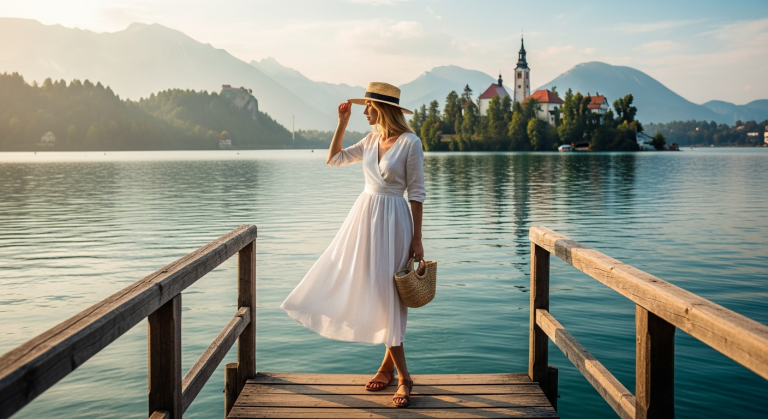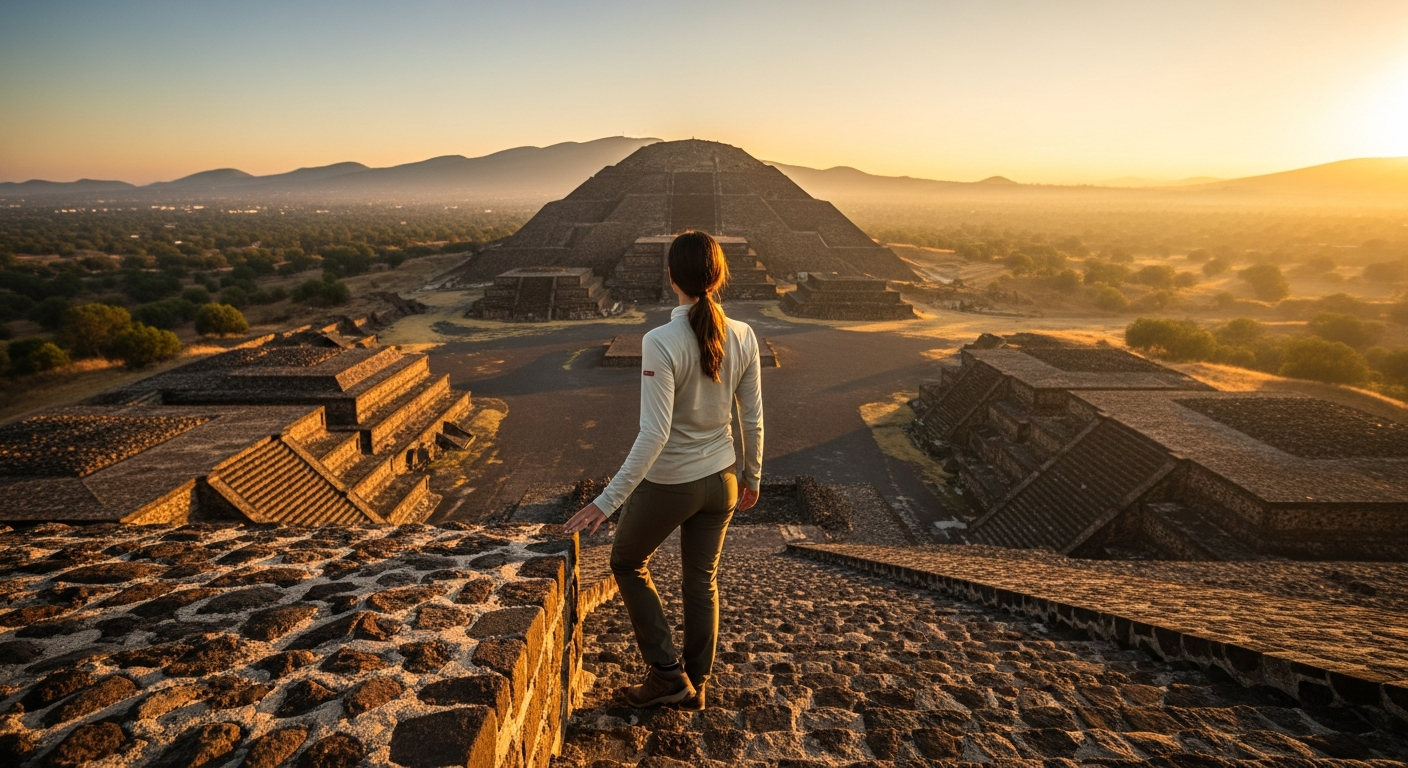
Teotihuacan, Mexico Summer Outfit Ideas

Practical summer outfit formulas for Teotihuacan pyramid climbing. Closed-toe shoes, sun protection, layering for dawn tours, and photo-ready styles that actually work on ancient steps.
At 6:47 AM, you’re already in a van heading northeast toward Teotihuacan in clothes that felt perfect in your hotel room but are already wrong.
You’re wearing cute linen shorts and minimalist sneakers—the kind that work for Condesa cafés—and by the time you reach the base of the Pyramid of the Sun, you’ll understand why.
The 248 uneven steps rise at a brutal 32-degree angle. Your shorts ride up when you squat for photos. Your shoes slip on smooth, worn limestone.
You’re watching other visitors in proper hiking gear move past you with ease, and you’re realizing that Teotihuacan isn’t a typical Mexico City day trip. It’s a three-to-four-hour physical challenge in extreme sun exposure on an archaeological site where every step matters.
Most Mexico packing lists focus on beaches, colonial towns, or trendy neighborhoods where you can duck into shade or air-conditioned restaurants.
Teotihuacan is different. You’ll spend hours in direct sun with zero shelter, climbing steep ancient steps, walking 1.5+ miles across exposed plazas, and interacting with a sacred space that deserves respectful coverage.
You need outfit strategies that handle 90°F+ heat without leaving you exposed to intense altitude sun, provide mobility for serious climbing, offer pockets and support for hours of walking, and still photograph well for the iconic pyramid backdrop shots.
This isn’t about looking like you’re summiting Everest. It’s about choosing breathable fabrics, proper footwear, and layering that adapts from 55°F dawn departures to scorching midday heat.
Why Teotihuacan Outfits Need Different Planning Than Typical Mexico City Travel

Mexico City’s historic center offers covered walkways, shaded plazas, and air-conditioned museums where you can escape the heat. Teotihuacan offers none of this. The pyramid complex sits on a high-altitude plateau with virtually no tree cover and minimal shelter options. You’ll spend three to four hours in direct sunlight with nowhere to hide.
The site sits at 7,350 feet elevation, which means the sun intensity burns faster than at sea level. UV rays are stronger and more direct. You can sunburn in under an hour without proper protection.
The Pyramid of the Sun requires climbing 248 steps with heights ranging from 8 to 16 inches on surfaces worn smooth by centuries of foot traffic.
Some stones are stable; others crumble slightly under weight. You’ll need both hands free on steeper sections. The Pyramid of the Moon adds another 150+ steps.
The Avenue of the Dead stretches 1.5 miles across open ground. This isn’t a casual stroll—your outfit needs to support serious hiking-level exertion in heat.
Summer in central Mexico brings afternoon rainy season patterns (June through September). You might depart in clear 55°F dawn conditions and encounter a 30-minute downpour by 2 PM, followed by return to intense sun.
Your outfit needs to handle temperature swings from cool to hot and unexpected moisture without becoming waterlogged.
Beyond the physical logistics, cultural respect matters. Teotihuacan holds ongoing spiritual significance for many visitors and some local communities.
While there’s no enforced dress code, overly revealing clothing feels out of place. The practical irony is that respectful coverage (long sleeves, knee-length bottoms, closed-toe shoes) also provides the best sun and dust protection. Your outfit can serve both purposes simultaneously.
Most organized tours depart Mexico City between 6 and 7 AM to beat crowds and heat. This means you’re dressing in cool morning temperatures for conditions that will shift dramatically by mid-morning. You need a layering strategy that works at dawn without leaving you carrying bulky jackets by 9 AM.
Complete Footwear Strategy for Pyramid Climbing

Your footwear choice makes or breaks the Teotihuacan experience. This is the single most important outfit decision, and it’s where most travelers fail. Those cute Mexico City sneakers you love—the minimalist canvas shoes, the fashionable slip-ons—will not work on ancient pyramid steps.
Teotihuacan’s steps aren’t uniform modern stairs. They’re ancient stones worn smooth in some spots and crumbling in others. Heights vary wildly—some steps are 8 inches, others are 16 inches. The surface is uneven, with no consistent tread. The Pyramid of the Sun’s angle is approximately 32 degrees, which means you’re essentially hiking. One loose shoe or one step on an unstable stone and you’re at risk of a twisted ankle or fall.
Closed-toe shoes are non-negotiable. Hiking sandals expose the tops of your feet to intense sun, leave toes vulnerable to stubbed toes on protruding stones, and provide zero ankle support on uneven surfaces. You need actual shoes.
The Shoe Formula That Works
Lightweight hiking shoes or trail runners with aggressive tread are ideal. You want something designed for uneven terrain with substantial sole grip and ankle support. The shoe needs to be broken in before your trip—new shoes guarantee blisters during hours of climbing. Test your planned footwear on regular stairs at home first. If they feel slippery or unsupportive on standard steps, they’ll be genuinely dangerous on ancient pyramid stones.
If you don’t own hiking shoes, a quality athletic shoe with substantial sole grip can work, but it needs real tread—not smooth soles. Avoid all-white sneakers (dust stains permanently). Avoid heavy hiking boots (they’re overkill in summer heat). Avoid brand-new shoes (blisters are guaranteed).
Moisture-wicking hiking socks prevent the sweat-dust paste that forms inside shoes during summer climbs. Regular cotton socks absorb sweat, stay wet, and create friction that leads to blisters. Ankle-height or crew-length socks protect against shoe rub on steep descents. Bring a spare pair in your day bag. Changing into dry socks at the halfway point is an underrated comfort boost that keeps you going for the second half of your visit.
Vacation Outfits That Handle Extreme Sun and Heat

Once your footwear is locked in, fabric choice becomes everything. Most vacation outfits for hot weather prioritize looking breezy over actual sun protection. Teotihuacan demands both.
The Fabric Technology That Actually Works
Linen blends (not 100% pure linen, which wrinkles excessively and shows every dust mark) offer breathability with structure. Moisture-wicking synthetic blends designed for hiking provide sun protection built into the fabric itself. Look for labels that specify UPF 50+ sun protection—this means the fabric blocks ultraviolet rays.
Avoid 100% cotton. Cotton absorbs sweat, stays wet against your skin, and provides zero sun protection when damp. A wet cotton shirt clings to you and actually traps heat. Long sleeves made from moisture-wicking synthetic or linen blend keep you cooler than short sleeves plus sunscreen because the fabric doesn’t sweat off and prevents direct sun contact with your skin. Fabric blocks direct sun from heating your skin, and the breathable weave allows air circulation. You’ll be noticeably cooler in a lightweight long-sleeve sun shirt than in a t-shirt plus exposed arms.
Color Strategy for Heat vs. Dust Reality
Light colors reflect heat and are essential for heat management in 90°F+ direct sun. But Teotihuacan’s reddish-brown dust shows on white and very light clothing. The best compromise is light khaki, tan, dusty rose, sage green, or light blue. These colors reflect heat effectively, photograph well, and forgive dust better than pure white. Dark colors absorb heat dangerously fast—black is a genuine health risk in extreme sun and high altitude.
Breathable long-sleeve sun shirts designed for outdoor activity keep you cooler than bare arms plus sunscreen. Roll-tab sleeves let you adjust as temperatures climb from dawn coolness to midday heat. Loose fit is crucial—tight sleeves trap heat; you want air circulation between the fabric and your skin. A UPF-rated sun hoodie with thumb holes protects the backs of your hands (an often-forgotten sunburn spot) and your entire neck without feeling heavy.
Outfits For Mexico That Work for Archaeological Sites

Your bottom half needs to balance mobility for steep climbing, modest coverage for cultural respect, and practical pocket placement for hours of walking. This is where many vacation outfits fail at archaeological sites.
Bottoms: Mobility Meets Modesty
Lightweight hiking pants with stretch (designed for outdoor activity, not fashion) handle steep climbing without restriction. Nylon or polyester blends with spandex move with you on uneven terrain and dry quickly if you encounter afternoon rain. Knee-length shorts work if they’re not too short—you’re squatting for photos, sitting on stones, and climbing steep steps where very short shorts ride up awkwardly. Flowy midi skirts become problematic on pyramid climbs. Wind exposure is real on the Pyramid of the Sun’s upper levels, and movement restriction is dangerous when you need both hands free on steep sections. Convertible zip-off pants are a secret weapon: start with full-length coverage during cool morning, convert to shorts by 10 AM when temperature climbs.
Pockets are non-negotiable. You need accessible pockets for your phone (constant photos), entrance ticket, small bills for vendors, and lip balm. Cargo-style pockets on pants or shorts keep your hands free during climbs. If wearing a skirt or dress, pair it with a belt bag in leather or canvas. This keeps essentials accessible without a bulky backpack and looks intentional in photos.
The Instagram-perfect flowing dress looks stunning in photos but is impractical for actual pyramid climbing. The compromise: bring a lightweight kimono, oversized button-up shirt, or structured linen overshirt in your day bag. Wear it for photos at scenic spots—the Pyramid of the Sun summit, the Avenue of the Dead vistas—then remove it for active climbing. A fitted base layer underneath gives you both functionality during climbing and a photogenic layered look for photos.
Travel Mexico Outfits: Layering for Dawn Departures

Most organized Teotihuacan tours depart Mexico City between 6 and 7 AM. This creates a specific outfit challenge: you’re dressing in cool morning temperatures (typically 55-60°F in Mexico City, even cooler at Teotihuacan’s higher elevation) for conditions that will shift dramatically within two to three hours. By 10 AM, you’re in 80-85°F temperatures. By noon, you’re in 90°F+ heat. You need 20-30°F temperature range coverage without carrying a heavy bag.
The Perfect Dawn Tour Layering Formula
Base layer: a moisture-wicking tee or tank that you’ll wear for most of the visit. Mid layer: a lightweight long-sleeve sun shirt in light blue or tan (worn over the tank). Outer layer: a packable windbreaker or thin zip hoodie worn for the first hour, then tied around your waist or stuffed into your day bag. This three-layer system handles the temperature range without excess bulk. Avoid cotton sweatshirts (too hot once sun rises) and denim jackets (heavy and restrictive for climbing).
The windbreaker is key. It needs to be genuinely packable—something you can compress into a small bundle that fits easily in a day bag. It should be water-resistant (not waterproof, which traps humidity) in case of afternoon rain. A thin synthetic or nylon shell works better than fleece, which is bulkier and heavier. By 9 AM, you’ll remove it and never think about it again, but those first 90 minutes of your visit are noticeably cooler, and having that layer makes early morning climbing more comfortable.
Accessories That Adapt to Temperature Shifts
A lightweight scarf serves triple duty: neck warmth at dawn, dust protection during windy moments on pyramid upper levels, and head covering for extra sun protection during midday exposure. Choose a fabric that’s breathable and compact when rolled—cotton gauze or a synthetic blend that compresses small. Fingerless gloves might sound excessive for Mexico in summer, but pyramid wind at dawn is real, especially on the Pyramid of the Moon’s exposed upper levels. Sunglasses that stay secure are essential. You’ll want them off for dawn photos, but they’re critical by 8 AM when the sun is strong. Choose styles with a strap or secure fit that won’t slip during climbing.
Chichen Itza Outfit Principles That Apply to All Pyramid Sites

If you’ve researched outfits for other major Mexican archaeological sites like Chichen Itza in Yucatan, you might wonder what translates to Teotihuacan and what’s specific to this location. Most pyramid site outfit principles apply across locations: sun protection through clothing is essential everywhere, closed-toe shoes with grip are non-negotiable at any site with uneven ancient steps, modest coverage shows respect for sacred spaces, and mobility for climbing is required.
However, Teotihuacan allows pyramid climbing, while Chichen Itza closed climbing access in 2008. This means your outfit at Teotihuacan needs more athletic capability and support than Chichen Itza, where you’re primarily walking and viewing from ground level. Teotihuacan sits at 7,350 feet elevation, creating stronger sun intensity despite potentially lower temperatures than Yucatan sites. Teotihuacan is significantly less humid than Yucatan pyramid sites, which means breathable layers work better than pure moisture-wicking fabrics designed for tropical humidity. The dust factor is higher at Teotihuacan due to the drier climate—your outfit will show dust more visibly, which influences color choices. If you’re visiting both sites during a Mexico trip, plan your outfit strategy separately for each location rather than trying to make one outfit work for both.
Ciudad De Mexico Outfit Ideas Extended to Day Trips

You’ve likely researched what to wear in Mexico City itself—the trendy neighborhoods, the museums, the evening dining scene. Teotihuacan is a complete outfit pivot from that aesthetic. Here are specific outfit combinations for different Teotihuacan visit scenarios.
Sample Outfit #1: The Dawn Tour Classic
Lightweight hiking pants in khaki or olive with pockets and stretch. Moisture-wicking tank top as base layer. Long-sleeve UPF sun shirt in light blue or tan (worn over the tank). Packable windbreaker for the first hour. Trail runners or lightweight hiking shoes with aggressive tread. Wide-brim hat that ties under the chin. Crossbody bag or belt bag for essentials. Moisture-wicking crew socks. This combination handles the 55°F dawn, the warming to 90°F midday, the sun intensity, the climbing demands, and the dust. You’ll look intentional, not overdressed, and you’ll be genuinely comfortable for the entire visit.
Sample Outfit #2: The Mid-Morning Independent Visit
Knee-length hiking shorts in dust-forgiving tan. Breathable long-sleeve tee with roll-tab sleeves. Sports bra designed to be visible. Trail runners or closed-toe hiking sandals with ankle straps. Baseball cap plus lightweight scarf for neck protection. Small backpack for water and layers. This outfit skips the dawn layering complexity because you’re arriving when it’s already warm. You’ll face maximum sun exposure, so the long sleeves and hat are essential.
Sample Outfit #3: The Photo-Focused Traveler
Fitted hiking pants in a flattering cut. Solid-color fitted tank as your photo base layer. Oversized linen button-up shirt in a neutral tone (remove for climbing, add for scenic photos). Supportive hiking shoes that don’t look overly technical. Statement hat—a wide-brim felt or structured straw that holds its shape and photographs well. Minimal jewelry that won’t snag or overheat. Belt bag in leather or canvas that’s functional but photogenic. This outfit prioritizes the aesthetic while maintaining functionality. The button-up gives you the breezy, intentional look for photos without sacrificing practical climbing capability.
What to Leave at Your Mexico City Hotel
Open-toe sandals and flip-flops—save these for evening in the city. White or very light clothing you care about keeping pristine—dust will stain it permanently. Heavy jeans or non-stretch pants—they restrict movement and trap heat. Delicate jewelry, expensive watches, or anything you’d worry about losing on ancient stones. Large purses or bulky backpacks—a small day bag is plenty. Excessive makeup—it’ll sweat off; go minimal with SPF products instead. High heels or fashion-forward shoes—they’re impractical and dangerous on uneven stone. Any clothing that requires careful handling or dry cleaning—you want washable, durable pieces you don’t have to worry about.
CONCLUSION
Teotihuacan demands a specific outfit formula that most Mexico packing lists completely miss. This isn’t a typical city day trip where you can adapt on the fly. The combination of extreme sun at high altitude, uneven ancient stone surfaces, steep climbing demands, hours of direct exposure with zero shade, and the need to respect a sacred space creates a unique set of constraints. But these constraints actually work together. The clothing that protects you from sun also provides respectful coverage. The shoes that grip ancient stones also keep you safe during steep climbs. The layers that adapt from dawn to midday heat also let you pack light. When you understand the specific demands of Teotihuacan, the outfit solution becomes clear.
Your footwear is the foundation of everything else. Closed-toe shoes with aggressive tread and ankle support aren’t optional—they’re essential for safety on uneven pyramid steps. Lightweight hiking shoes or trail runners designed for uneven terrain work best; test them on stairs before your trip. Moisture-wicking socks prevent blisters during hours of climbing. Your fabric choices matter more than you’d expect. Linen blends and moisture-wicking synthetics with UPF protection keep you cooler than cotton while actually protecting your skin from intense altitude sun. Light khaki, tan, sage, or dusty rose colors reflect heat while forgiving dust better than white. Long sleeves feel counterintuitive in heat but are genuinely cooler than short sleeves plus sunscreen because the fabric blocks direct sun contact.
Layering for dawn tours isn’t complicated once you understand the formula: a base layer you’ll wear all day, a long-sleeve sun shirt for UV protection, and a packable outer layer for early morning warmth that compresses into your day bag by 9 AM. Bottoms need pockets, mobility for climbing, and modest coverage. Accessories—a scarf, a secure hat, sunglasses—adapt to temperature shifts and serve multiple functions. The goal isn’t to look like you’re summiting Everest or to sacrifice aesthetics for pure function. It’s to choose practical technical pieces in photogenic colors and styles that let you climb comfortably, look intentional in photos, and respect the cultural significance of the space.
Your next move: test your shoes on stairs this week. If you don’t own hiking shoes with proper tread, invest in a pair now—this is the one non-negotiable piece. Check your tour departure time and plan your base layers around the temperature at that hour. Pack a small day bag and load it with water, sunscreen, your phone, and your outer layer; wear it for 20 minutes around your house to confirm it doesn’t bounce or dig in. Prep your sun protection: SPF 50+ for face and hands, lip balm with SPF, and after-sun lotion for your hotel room. Plan your Mexico City outfits separately from your Teotihuacan outfit—don’t try to make one wardrobe work for both the city and the pyramids. Consider booking a dawn tour if your schedule allows. Yes, the 6 AM departure is brutal, but you’ll experience the site with perfect golden light, significantly fewer crowds, and manageable temperatures. It’s worth the early alarm.