Volterra Italy Travel Guide

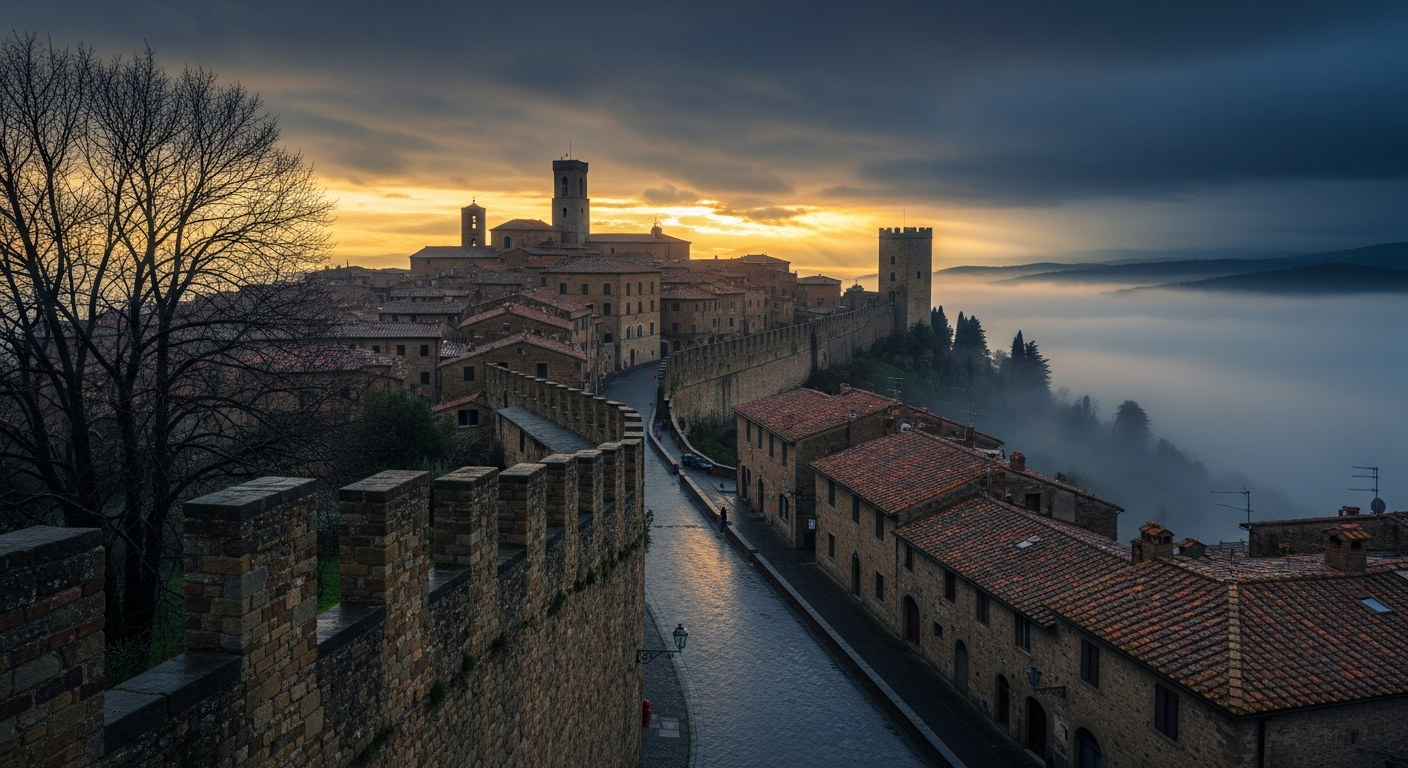
In Volterra it’s church bells from the 13th-century Palazzo dei Priori that wake you. While tour buses idle in San Gimignano’s parking lots and selfie-seekers crowd Florence’s Duomo steps, Volterra’s Etruscan gates stand quietly above three valleys, still guarded more by locals than tourists.
This is what authentic Tuscany feels like: a population of 10,000, alabaster workshops where fourth-generation carvers still work storefront studios, and Roman theater ruins visible from medieval streets that have functioned continuously for 2,000 years.
You have limited days in Tuscany and want authentic medieval atmosphere without sacrificing accessibility. You’re paralyzed choosing between hill towns, unsure which deserve overnight stays.
You want to experience Tuscany’s layers of history beyond Renaissance art—something that feels genuinely discovered rather than processed through a tour guide’s script.
This guide positions Volterra in your Tuscany itinerary with exact transport logistics, timing recommendations, and strategic pairing options.
You’ll understand what makes Volterra distinct: Etruscan depth predating Florence’s Renaissance by 2,000 years, artisan traditions still alive in working studios, and dramatic geography where medieval neighborhoods have eroded into ravines.
You’ll get concrete planning answers about arrival, accommodation, timing, and combinations. You’ll walk away with a buildable itinerary.
Why Volterra Tuscany Deserves Your Time
Volterra sits at 550 meters elevation on a dramatic hilltop where three valleys converge, making it geographically distinct from rolling vineyard landscapes. But the real difference is historical depth.
Etruscan Origins: History Deeper Than the Renaissance
Volterra (ancient Velathri) was a major Etruscan lucumony—a city-state of significant power—flourishing in the 4th century BCE.
While Florence spent the Renaissance reinventing itself as the art capital of Europe, Volterra was already 2,000 years old, its Etruscan gates still standing.
The Porta all’Arco archway, with three weathered Etruscan head sculptures carved into the stone, remains one of the oldest city gates still in use anywhere in Italy.
The Guarnacci Etruscan Museum houses over 600 funerary urns—the largest collection outside Rome’s Villa Giulia. The “Ombra della Sera” (Shadow of the Evening), a 3rd-century BCE bronze figurine with an impossibly elongated human form, inspired Alberto Giacometti’s later sculptures.
Spend 90 minutes here and you’ll understand why Volterra matters: it’s the archaeological layer most Tuscany visitors never reach. Every medieval palazzo sits atop Etruscan foundations, every street follows routes established before Christ.
Authentic Scale: Locals Still Outnumber Visitors
A population of 10,000 means Volterra has real infrastructure—grocery stores where locals actually shop, working bakeries that open at 6 AM for residents, trattorias where the table next to you speaks Italian without translation apps.
You’re in a functioning medieval community where elections are announced from 13th-century balconies, where the weekly market (Saturday mornings) is for locals buying vegetables, not visitors buying souvenirs.
This authenticity creates a trade-off: fewer English menus, less convenient signage, fewer accommodation options. But you’ll never feel like you’re in a theme park.
The baker knows regular customers by name. The alabaster carver will tell you about his family’s 400-year tradition without trying to upsell you. This is what travelers mean when they say they want “authentic Tuscany”—and it’s actually available here.
Strategic Position Between Coast and Cities
Volterra sits 50 kilometers from Florence, 30 kilometers from Siena, and 45 kilometers from Pisa. More importantly, it’s 45 minutes from the Bolgheri wine region and one hour from Tuscan beaches near Castiglioncello.
Most travelers treat Tuscany as a landlocked hill-town circuit. Volterra is your bridge to the coast—ideal if you’re combining hill towns with a beach week or wine-region exploration.
It’s also the natural overnight stop between Florence and Siena if you’re doing a multi-city loop, offering something neither major city can deliver: genuine medieval atmosphere without tourist saturation.
Things to Do in Volterra: Beyond the Checklist
Volterra’s attractions aren’t designed for speed-running. The Guarnacci Museum isn’t a 15-minute photo stop; it’s a 90-minute immersion in Etruscan civilization.
The Balze cliffsides aren’t a scenic overlook; they’re a sobering walk through geological time and medieval loss. Here’s what actually deserves your time.
Guarnacci Etruscan Museum: The Foundation for Everything
Start here before exploring anything else in town. The museum provides historical context that transforms a medieval walk into an archaeological journey.
The “Shadow of the Evening” bronze figurine is the headline piece, but spend time with the funerary urns. Each one tells a story: portrait lids showing Etruscan faces, inscriptions naming families, scenes carved into the boxes showing banquets and journeys. These are 2,500-year-old snapshots of people who lived on this exact hilltop.
Budget 90 minutes; entry costs €8-12. The museum is located in Palazzo Minucci-Solaini on Via Don Minzoni. Photography is typically allowed without flash.
After exiting, walk directly to Porta all’Arco—you’ll see the actual Etruscan gate you’ve just learned about, and the experience will hit differently.
Porta all’Arco: The Gate That Survived Everything
This 4th-century BCE archway with three weathered Etruscan head sculptures is the most emotionally resonant site in Volterra. The heads are worn smooth by 2,400 years of weather and human touch.
During World War II, Volterra residents filled this gate with stones to prevent German demolition. After liberation, they excavated it stone-by-stone, restoring it to standing. The gate survived conquest, erosion, war, and reconstruction.
Walk through it from Piazza dei Priori heading downhill on Via Porta all’Arco—about a 5-minute walk. The approach itself descends into older sections of town, moving backward in time.
Photograph it in morning light (6-8 AM) before crowds arrive, or at sunset when the stone glows warm. It’s free to pass through with no entrance fee or time restriction.
Roman Theater and Archaeological Park
Below the town walls on the eastern side, a 1st-century BCE Roman theater complex sits excavated and partially restored. You can see it clearly from Via Francesco Ferrucci overlook without paying.
The site continues revealing new sections as archaeologists work. Entry to walk the site costs €5-8, and it’s worth it for standing in the orchestra area where actors performed 2,000 years ago.
The theater is best photographed in morning light when shadows define the stone seating rows. Combine this with the medieval wall walk that passes above it—you get Roman history below and medieval defense engineering above, all visible in a 20-minute loop.
This is where Volterra’s layers become visible: Etruscan foundations, Roman entertainment, medieval fortification, all occupying the same hilltop.
Alabaster Workshops and the Artisan Quarter
Local alabaster has been quarried and carved since Etruscan times. Walk through streets around Via Porta all’Arco and you’ll find workshops where carvers still work the stone by hand—not as tourist demonstrations, but as actual artisans fulfilling commissions.
The Ecomuseo dell’Alabastro explains the geological formation and 3,000-year carving tradition for €4-6 entry. Workshops like Alab’Arte and Rossi Alabastri offer demonstrations without pressure to purchase, though pieces start at €15-20 for small items and climb to hundreds of euros for serious sculptures.
The real experience isn’t buying—it’s watching someone carve translucent stone into forms that seem almost liquid. Spend 20-30 minutes wandering these workshops.
You’ll likely have conversations with artisans who’ve inherited their skills from parents and grandparents. This is craft tradition still alive, not performed for tourists.
The Balze Cliffs: Medieval Volterra Disappearing
On the eastern edge of town, clay cliffs are slowly eroding—consuming entire medieval neighborhoods that once stood where now there’s only ravine.
An 11th-century abbey teeters on the cliff edge, slowly sliding downward. The Viale dei Ponti walking path offers views of this geological drama: medieval buildings visible in cross-section as they crumble into ravines below. It’s sobering and stunning simultaneously—a reminder that even medieval stone doesn’t last forever.
Walk this at sunset (6-8 PM depending on season) when light turns the clay ravines golden and shadows deepen the erosion patterns. It’s 20 minutes from town center, mostly level walking on an unpaved path. Bring sturdy shoes and a camera. This is the experience that stays with you: not a checklist item, but a moment of perspective about time and loss.
Volterra Italy Travel Guide: Getting There and Around
Volterra’s hilltop location creates both its charm and logistical complexity. It’s not on a major train line, and buses run on schedules designed for residents, not tourists. Understanding your transport options is essential for building a realistic itinerary.
From Florence: Car vs. Bus Trade-offs
Driving from Florence takes 1 hour 15 minutes via the SR68 highway—straightforward and direct. The bus route (SITA/Tiemme line 131 to Colle di Val d’Elsa, then transfer to Volterra service) takes 2.5 hours total, requires coordination between two operators, and runs limited schedules (typically 2-3 daily connections). If you’re staying in Florence and want to visit Volterra as a day trip, a rental car is nearly essential.
Parking outside the town walls is straightforward: Docciola lot and Martiri lot charge €2/hour with free shuttle service to Piazza dei Priori every 15 minutes.
Don’t attempt to drive into the historic center—resident-only vehicle zones (ZTL) are enforced with automated cameras, and fines are €100+. Once parked outside walls, everything in town is walkable in 15 minutes end-to-end, though steep in sections.
From Siena: Shorter Distance, Similar Logic
Siena to Volterra is 50 kilometers (driving 50 minutes). Public transport requires a train to Poggibonsi plus a bus connection (2 hours total with waiting time).
Car rental is the practical choice if you want flexibility. If you’re basing yourself in Siena and want to visit Volterra as a half-day excursion, you’d spend more time traveling than exploring. Better to commit to either a full day with a rental car or an overnight stay with public transport.
From Pisa: Driving Recommended
Pisa to Volterra is 75 kilometers by car (1 hour 15 minutes). Public transport is impractical—multiple transfers, 3+ hours, and schedules that don’t align well. If you’re flying into Pisa and planning a Tuscany loop, rent a car at the airport.
Navigating the Hilltop: Parking, Walking, Accessibility
The historic center is compact—15 minutes walking end-to-end—but built on steep terrain with cobblestone streets and staircases.
Comfortable walking shoes are essential. The Roman Theater requires descending a steep path; the Balze walk is mostly level but unpaved. If you have mobility limitations, the historic center is challenging.
Consider staying at an agriturismo outside town (5-minute drive to parking) rather than a historic-center hotel where you’d need to climb multiple staircases with luggage.
Museums have limited elevator access. Palazzo dei Priori interior requires climbing stairs. The Guarnacci Museum has partial accessibility.
Plan your route to minimize elevation changes if stairs are a concern. No local transport is necessary within town—taxis exist but aren’t needed for the compact center.
Where to Stay in Volterra: Choosing Your Base
Your accommodation choice determines whether you experience Volterra as a daytime museum or as a living medieval town. The difference between arriving at 10 AM (when day-trippers are filtering in) and waking up at 7 AM (when church bells echo across empty streets) is profound.
Historic Center Hotels: Medieval Immersion
Staying inside the walls means waking to church bells, walking to breakfast through streets where locals are opening shutters, and experiencing the town after 6 PM when day-trippers have departed. Mid-range hotels in the historic center typically cost €90-150 per night.
Many occupy 14th-century buildings with original frescoes, stone arches, and narrow staircases. You’ll carry luggage on cobblestones, parking is outside walls (but managed by your hotel), and rooms can be small by modern standards.
Book 2-3 months ahead for May-September visits. The experience is worth the logistics. You’ll have morning light on Piazza dei Priori before crowds arrive, and you can return to your room for afternoon rest without the 45-minute drive back to Florence.
Countryside Agriturismi: Tuscan Postcard Views
Working farms and wine estates 5-15 minutes outside town walls offer 360-degree valley views, pool access (May-September), and breakfasts featuring estate olive oil and homemade preserves.
Rates typically run €80-140 per night. You’ll need a car, but you get sunset terrace experiences impossible in town center—watching light fade across three valleys while swallows dive through the air.
Many require 2-night minimum stays in high season, which works in your favor if you’re committing to Volterra as a real overnight destination.
Agriturismi feel less touristy than hotels; you’re staying in an actual working property, eating breakfast with the owner’s homemade jam.
The downside: reduced walkability (you need a car to reach town center), and some properties are isolated if you prefer being near restaurants and activity.
Book direct with properties rather than through booking platforms—you’ll often save 10-15% and get better information about what’s actually included.
Day Trip vs. Overnight: Making the Strategic Choice
Day-tripping works only if you’re based in Florence or Siena with a rental car, visiting May-September when daylight lasts until 8+ PM.
You’ll see major sites but you’ll miss the atmospheric experience. You’ll arrive at 10 AM when other day-trippers are filtering in, and you’ll leave by 5 PM before the town settles into evening rhythm.
Overnight is essential if you want to experience Volterra as a living place rather than a destination. It’s non-negotiable if you’re planning to visit the Bolgheri wine region or Tuscan coast—Volterra becomes your logical base.
It’s also worth it if this is your only deep-dive hill town. Recommendation: commit to at least one night. The twilight experience, the morning light, the conversations with artisans unhurried by tour schedules—these are what make Volterra distinct.
When to Visit Volterra for the Perfect Experience
Timing shapes whether you experience Volterra as an authentic town or as a curated destination. Seasonal crowds, weather patterns, and festival timing all matter more than you’d expect.
Seasonal Sweet Spots and Crowd Patterns
April-May brings wildflowers to the countryside, comfortable temperatures (15-22°C), and Easter-week crowds that are manageable compared to summer.
June-August is peak season—hot (28-35°C), busy, but never Florence-level crowded. Book accommodations 2+ months ahead.
September-October is the secret sweet spot: harvest season, wine festivals in nearby regions, perfect weather (18-25°C), and fewer tourists. November-March is quiet but many agriturismi close, museum hours reduce, and restaurant options narrow. If you’re choosing dates strategically, aim for late September or early October.
Festivals and Cultural Events
Volterra AD 1398 (third or fourth Sunday in August) recreates medieval life with crossbow competitions, period costumes, and artisan markets.
Teatro Romano hosts summer performances (July-August) in the actual 2,000-year-old theater—a stunning setting regardless of the production.
Alabaster exhibitions rotate through the Pinacoteca; check discovervolterra.it for current installations. These events add atmosphere but also increase crowds. Plan around them based on whether you want festive energy or quiet exploration.
Light and Photography: Timing for Visual Impact
Morning light (8-10 AM) hits Piazza dei Priori when it’s empty, the Roman Theater shows dramatic shadows that define the stone seating, and artisan workshops are opening. Midday is museum hours and lunch time.
Evening (6-8 PM) transforms the Balze cliffs to gold, Porta all’Arco glows warm, and the town shifts from daytime to evening rhythm.
Overnight guests capture this twilight magic when day-trippers have departed. Sunrise here—if you’re awake—is genuinely unforgettable, with light spreading across three valleys and church bells echoing across empty streets.
Volterra Travel Guide: Practical Planning Tips
The difference between a chaotic Volterra visit and a seamless one comes down to small logistical decisions: how long to allocate, what to combine it with, where to eat, how much money to bring. Here’s what actually matters.
Time Allocation: Minimum to Optimal
Four hours minimum gets you Guarnacci Museum (90 minutes), Porta all’Arco, Piazza dei Priori, quick alabaster browse, and Roman Theater overlook.
Six to eight hours (full day) adds Balze walk, sit-down trattoria lunch, artisan workshop conversations, and Palazzo dei Priori interior.
Twenty-four hours overnight captures everything above plus evening atmosphere, morning market (Saturday), relaxed pace, and nearby winery visits.
Two nights allows a day trip to Bolgheri wine estates or coastal Populonia archaeological site. If you have 10 days in Tuscany, allocate minimum 24 hours in Volterra. If you have 5 days, commit to either one full day or skip it for Florence/Siena depth.
Strategic Combinations: Building Your Multi-Town Loop
San Gimignano is 30 kilometers away—do Volterra morning, San Gimignano afternoon, or reverse. Parking is easier in Volterra; San Gimignano’s lot is chaotic in peak season.
The Bolgheri wine region (45 kilometers) is perfect for an overnight base near Volterra—book Sassicaia and Ornellaia tastings ahead.
The Tuscan coast (Populonia Etruscan ruins 50 km, Castiglioncello beaches 60 km) is less crowded than Cinque Terre and works naturally as a Volterra day trip.
Siena and Florence are both 30-50 kilometers away, making Volterra a logical overnight stop between them rather than a detour.
Budget Realities and Money-Saving Strategies
Museum cumulative tickets (Guarnacci + Pinacoteca + others) cost €14-18 versus €8-12 individual entries—worthwhile if visiting 3+ sites. Lunch at an alimentari (local grocery) with porchetta sandwiches and wine runs €8-12 versus €25-35 for sit-down trattoria. Free experiences include Porta all’Arco, Roman Theater overlook, Balze walk, medieval street wandering, and artisan window-shopping. Agriturismo breakfast included saves €8-12 versus hotel breakfast add-ons. Book agriturismi direct for 10-15% savings versus booking platforms. Overall budget expectation: €100-150 per person per day (accommodation + meals + museums + transport) in mid-range tier.
Cultural Etiquette and Local Customs
One insight that transforms your visit: Italians don’t separate “tourist time” from “local time” the way English-speaking countries do. If you’re in a trattoria at lunch, you’re expected to sit for the full experience, not rush. Ordering just coffee and sitting for two hours is socially acceptable. Asking an alabaster carver about their work is welcome; treating them as a museum display is not. Shop hours close 1-4 PM for lunch; plan around this rather than resenting it. Church hours matter—many sites close during afternoon mass. Greet shopkeepers with “Buongiorno” or “Buonasera” when entering; it’s basic respect. Dress modestly in churches (shoulders covered). These small adjustments make the difference between being a tourist moving through and being a visitor respectfully present.
Conclusion
Volterra delivers what most Tuscany travelers claim to want but rarely find: authentic medieval atmosphere without tour-bus saturation. The Etruscan history runs 2,000 years deeper than Florence’s Renaissance. The artisan traditions are still alive in working studios, not museum recreations. The population of 10,000 means you’re in a functioning town where locals outnumber visitors, not the reverse. The dramatic geography—three valleys visible from the walls, clay cliffs eroding medieval neighborhoods into ravines—creates landscape that stays with you months after you leave.
The practical reality: Volterra requires a car to visit efficiently (or a commitment to overnight stay if using buses), allocates minimum 4-8 hours of your Tuscany days, and rewards slowing down rather than speed-running. It pairs naturally with San Gimignano for a two-town loop, or with Bolgheri wine estates and Tuscan coast for a broader exploration. September-October offers the best combination of weather, fewer crowds, and harvest-season energy. Overnight stay is non-negotiable if you want the complete experience—morning light, evening atmosphere, unhurried conversations with artisans, and the specific magic of a medieval town after day-trippers depart.
Your next move: Book accommodation 2-3 months ahead for May-October visits (choose historic center for immersion or countryside agriturismo for views and pools). Download the Volterra walking map from discovervolterra.it and mark Guarnacci Museum, Porta all’Arco, Roman Theater, and Balze overlook as anchor points. Reserve a car rental early if visiting multiple hill towns—public transport limits same-day combinations and spontaneous detours. Check museum hours before arrival (reduced November-March); plan the Guarnacci visit first for historical context that enriches everything else you’ll see. Most importantly, build in buffer time for unplanned discoveries—the alabaster workshop conversation or sunset aperitivo that becomes your trip’s unforgettable moment. That’s what Volterra offers: not a checklist destination, but a place where authentic Tuscany still exists if you slow down enough to find it.