backpacking for central asia

I was crammed in the back of a shared taxi somewhere between Bukhara and Khiva when the driver pulled over at a roadside teahouse.
What I assumed would be a five-minute stop turned into an hour-long feast—the driver’s cousin owned the place, and suddenly platters of plov, fresh bread, and endless pots of green tea appeared.
My share of this banquet? About $2. This is Central Asia: where your limited vacation time transforms into an epic adventure, your budget stretches impossibly far, and authentic experiences aren’t something you hunt for—they’re simply the default setting.
If you’re overwhelmed by planning your next backpacking trip, tired of overcrowded Southeast Asian routes, or worried about maximizing your precious time off, Central Asia offers something magical that’s becoming increasingly rare: genuine discovery.
The Silk Road cities of Uzbekistan rival anything in Europe for architectural grandeur. Kyrgyzstan’s mountain valleys deliver trekking that matches Nepal without the crowds.
And you’ll do it all for a fraction of what you’d spend almost anywhere else. Here’s everything you need to know to make it happen.
Why Central Asia Is Perfect for Backpackers (And Why Now Is the Time)

Your Budget Goes 3X Further Than Southeast Asia
Let me give you the numbers that matter. I spent 30 days backpacking through Kazakhstan, Kyrgyzstan, Tajikistan, and Uzbekistan on $25 per day—and that wasn’t survival mode.
That included comfortable guesthouse beds, restaurant meals (not just street food), shared taxis between cities, and entrance fees to every monument I wanted to see.
Compare this to Southeast Asia, where $25 barely covers a decent hostel and meals in tourist areas anymore. In Central Asia, you’re looking at $3-5 for a dorm bed in the few hostels that exist, $2-3 for a massive plate of plov (the region’s signature rice pilaf loaded with meat and vegetables), and $1-2 for fresh samsa (meat-filled pastries) from street vendors.
A filling lagman noodle soup in a local restaurant runs about $2. Even in the tourist epicenter of Samarkand, I never paid more than $8 for a restaurant meal that left me uncomfortably full.
The real secret most travelers miss: homestays. For $10-15 per night, you get a bed, breakfast, and usually dinner too—home-cooked, multi-course affairs where you’ll eat better than in most restaurants.
In Kyrgyzstan’s Jyrgalan Valley, my homestay cost $12 including three enormous meals. The family slaughtered a sheep in my honor (this is both a privilege and a lot of mutton).
If you want more comfort, $20-25 gets you private guesthouse rooms with your own bathroom. Want to splurge? In Uzbekistan, $40-50 puts you in restored medieval caravanserais with courtyards and traditional decor that would cost $200+ anywhere else. Shared taxi rides between cities—the backbone of Central Asian transport—run $5-15 for journeys of three to four hours. Your budget constraints simply aren’t constraints here.
Authentic Experiences Are the Default, Not the Exception
Here’s what I mean by authentic: in three weeks traveling through Uzbekistan, I encountered exactly four other Western backpackers. In Kyrgyzstan’s Song-Kol Lake, I was the only foreigner staying in a yurt camp with 30 Kyrgyz families. This isn’t because these places are hard to reach—it’s because mass tourism genuinely hasn’t arrived yet.
Why? Visa policies were restrictive until very recently. Uzbekistan only introduced its e-visa system in 2018. Turkmenistan remains intentionally difficult to visit. The infrastructure is developing but still basic in many areas—which sounds like a drawback until you realize it means you’re experiencing these places before they transform into the next Thailand.
The stunning reality is that local interactions happen constantly and naturally. The tea culture means you’ll be invited to sit down for conversations dozens of times. Shared taxis force interaction—you’re squeezed into a car with locals for hours, and they’re genuinely curious about you. In Tajikistan’s Pamir region, drivers stopped at their friends’ homes so I could meet their families. None of this was arranged or paid for. It just happens.
One misconception I need to address: “authentic” doesn’t mean primitive or uncomfortable. Central Asian cities have excellent wifi, modern hotels exist if you want them, and the food scene in places like Almaty and Tashkent is sophisticated. But unlike most destinations, you don’t have to work hard to avoid tourist traps or hunt for “hidden” local spots. The entire region is still operating primarily for locals, and you’re just along for the ride.
Visa Policies Have Never Been Easier
This is the game-changer that makes now the perfect time to visit. Uzbekistan’s e-visa takes 72 hours to process and costs $20 for 30 days. The application is straightforward—I completed mine in 15 minutes. Kyrgyzstan offers visa-free entry for 60 days to most Western passport holders. Kazakhstan recently extended visa-free stays to 30 days for citizens of 54 countries.
Tajikistan requires a visa, but you can get it as an e-visa in about a week for $50. The real requirement for Tajikistan is the GBAO permit (Gorno-Badakhshan Autonomous Oblast) if you’re visiting the Pamir Highway region—which you absolutely should be. You can apply for this online simultaneously with your visa for an additional $25. I received mine in five days.
The only genuine visa headache is Turkmenistan, which remains deliberately difficult. Most backpackers either skip it entirely or arrange a 5-day transit visa ($55) if they’re crossing from Uzbekistan to Iran or vice versa. You’ll need an official letter of invitation, which tour agencies can arrange for $50-80. Honestly? Unless you’re a completist or specifically fascinated by post-Soviet oddities, Turkmenistan isn’t worth the hassle for most backpackers.
Planning Your Perfect Central Asia Backpacking Route

The Classic 30-Day Silk Road Circuit
If you have a month and want to maximize your limited vacation time while hitting the ultimate highlights, this is your route: Almaty (Kazakhstan) → Bishkek (Kyrgyzstan) → Osh → Dushanbe (Tajikistan) → Samarkand (Uzbekistan) → Bukhara → Khiva → Tashkent.
Why this sequence? It follows natural transport connections and builds from modern cities into increasingly historic environments, creating a perfect narrative arc. Start in Almaty for a gentle introduction—it’s the most cosmopolitan city in the region with excellent restaurants and nightlife. Spend two days adjusting to Central Asian rhythms.
Take a shared taxi to Bishkek (5-6 hours, $10-15 per person). Bishkek is younger and more Soviet in character, but use it as a base for day trips to Ala-Archa Canyon or Issyk-Kul Lake. Then comes the decision point: most backpackers fly to Osh in southern Kyrgyzstan ($40-60) rather than taking the 12-hour marshrutka ride. From Osh, cross into Tajikistan at the Kyzyl-Art Pass—this border crossing actually works well for independent travelers.
Dushanbe serves as your jumping-off point for the breathtaking Pamir Highway (budget 5-7 days for this). After the Pamirs, fly to Samarkand ($80-100)—the only practical way to make this connection. Now you’re in Uzbekistan’s historic heartland, and you can travel by shared taxi through Bukhara (4 hours) and Khiva (7 hours from Bukhara) before ending in Tashkent.
The hidden gem most people miss: add 3-4 days for Karakol and Jyrgalan Valley in Kyrgyzstan if you’re into hiking or adventure sports. Karakol sits on the eastern edge of Issyk-Kul Lake and offers access to incredible alpine trekking, while Jyrgalan is a community-based tourism project with some of the best homestays in the region.
The 2-Week Express: Uzbekistan Deep Dive
Limited vacation time? Two weeks in Uzbekistan alone delivers an unforgettable experience without the complexity of multiple countries and border crossings. The loop is simple: Tashkent → Samarkand → Bukhara → Khiva → back to Tashkent.
Spend two days in Tashkent exploring the Chorsu Bazaar and surprisingly good museums, then take the high-speed Afrosiyob train to Samarkand (2.5 hours, $15-25). This is where you’ll want to slow down—budget four days for Samarkand. The Registan Square alone deserves multiple visits at different times of day, and day trips to Shakhrisabz (Timur’s birthplace) or local ceramic workshops add depth.
Bukhara is three hours from Samarkand by shared taxi ($8-10). Give it three full days minimum—the old city is a living museum where you can wander for hours. The authentic local experience happens in the teahouses around Lyab-i-Hauz pond, where old men play chess and drink tea for hours.
Khiva requires a full day of travel from Bukhara (shared taxi or overnight train), but the walled city of Itchan Kala is worth every dusty kilometer. Two days here, then return to Tashkent via the overnight train ($25-40 depending on class).
Why Uzbekistan offers the most bang for your buck: the concentration of architectural wonders rivals anywhere on earth, the food is the best in Central Asia, and the infrastructure is the most developed for independent travelers. You’ll have authentic experiences while still having reliable transport and accommodation options.
The Adventure Route: Kyrgyzstan and Tajikistan Pamir Highway
If you’re a hiker, nature lover, or adventure seeker, forget the Silk Road cities and focus on Kyrgyzstan and Tajikistan. This route requires 3-4 weeks minimum and genuine physical preparation—you’ll be spending days at 3,000-4,000 meters altitude.
Start in Bishkek, but head straight for the mountains. Karakol (6 hours by marshrutka, $8) serves as your base for multi-day treks in the Terskey Alatau range. From there, arrange transport to Song-Kol Lake (high-altitude lake with summer yurt camps) or tackle the Jyrgalan Valley’s community-based tourism trails.
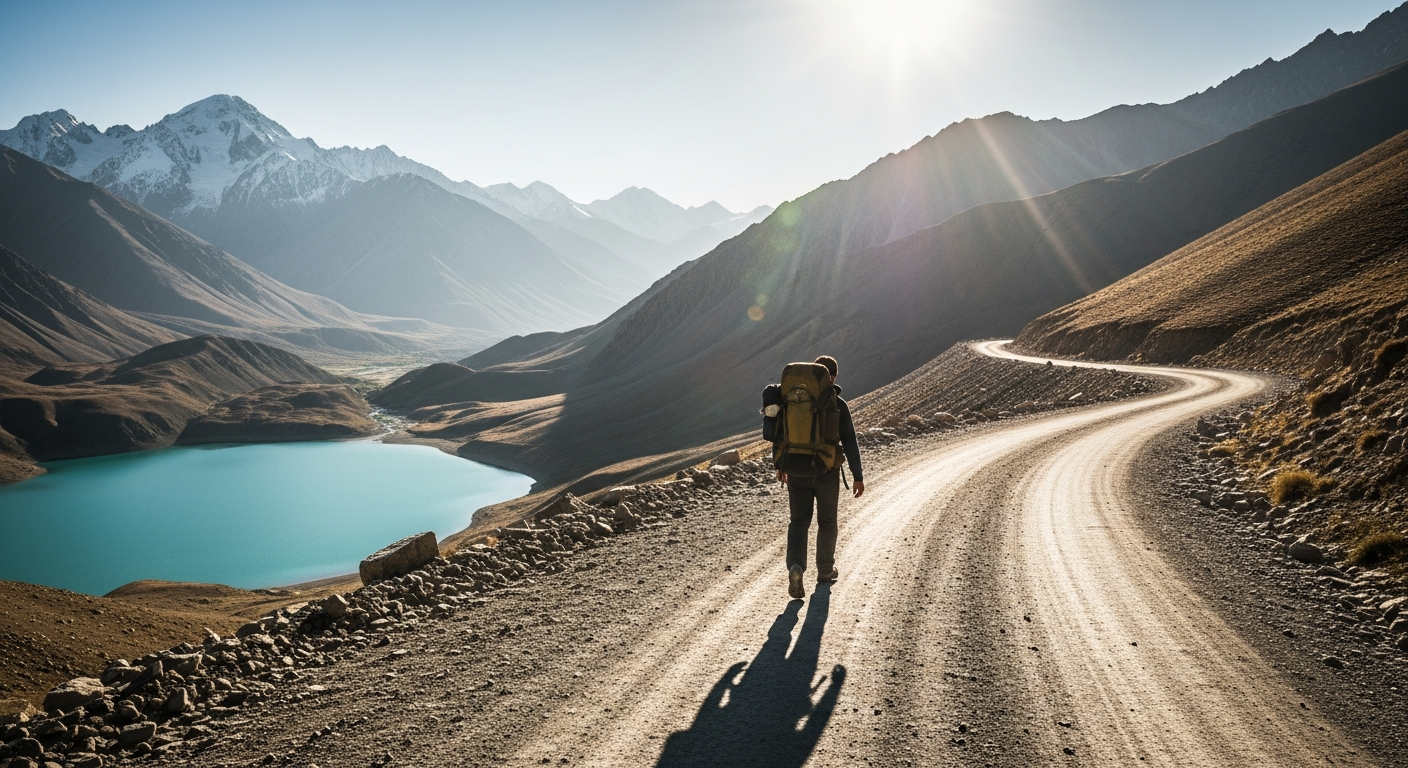
The main event is the Pamir Highway from Dushanbe to Osh via the GBAO region. This isn’t a single highway—it’s a network of rough roads through some of the most breathtaking mountain scenery on earth. Most travelers hire a 4×4 with driver ($100-150 per day split among passengers) or join organized tours ($50-70 per person per day in small groups).
The route passes through Khorog, crosses the 4,655-meter Ak-Baital Pass, visits Murghab (one of the highest towns in the world), and ends in Osh. Budget 7-10 days for the full journey with stops. Every night is a homestay in small Pamiri villages—these are genuine alpine communities where you’ll sleep on floor cushions and eat meals with families.
Physical preparation needed: if you’re not accustomed to altitude, you will feel it. Headaches, shortness of breath, and fatigue are normal above 3,500 meters. The best seasons are June through September—before June, high passes may still be snowed in; after September, temperatures drop dramatically. I did this route in July and still needed my down jacket every evening.
Border Crossing Reality Check
Not all Central Asian borders are created equal. The Kyrgyzstan-Kazakhstan border at Korday is straightforward—locals cross constantly for shopping, and marshrutkas run regularly. The Kyrgyzstan-Uzbekistan border at Dostyk (Osh to Andijan) works fine but can be slow; budget 2-3 hours for the crossing.
The Tajikistan-Kyrgyzstan borders are where things get interesting. The Kyzyl-Art Pass works well for travelers with proper permits, but the Kulma Pass (into China) is closed to independent travelers. The Uzbekistan-Tajikistan border situation is complicated by the fact that there’s no direct land border crossing open to foreigners—you’ll need to fly or route through Kyrgyzstan.
Shared taxi etiquette: the front passenger seat costs 1.5x the back seat price. Drivers wait until the car is full (4 passengers) before departing. You can pay for empty seats to leave immediately, but you’ll pay the full per-seat price for each empty spot. Negotiate prices before getting in—standard rates exist for common routes, and locals will tell you what’s fair if you ask.
The ultimate timeline advice: build in buffer days for unexpected delays. Shared taxis don’t run on schedules—they leave when full. Border crossings can take 30 minutes or 3 hours depending on the day. I learned this the hard way when a 4-hour journey from Bukhara to Khiva turned into 7 hours due to multiple tea stops and a flat tire. In Central Asia, the journey is part of the experience—embrace it rather than fighting it.
The Complete Central Asia Packing List (What Actually Matters)

The Perfect Backpack Setup for Central Asia
Forget the 70L monster pack. Central Asian travel means shared taxis where you’re cramming into tight spaces with other passengers and their cargo. I used a 55L Osprey Farpoint, and it was perfect—large enough for 30 days of gear but small enough to fit in car trunks without causing issues.
The ideal setup is a 50-65L main pack plus a 20-25L daypack. Your daypack serves triple duty: city wandering, day hikes, and as your carry-on for the few flights you’ll take. I used a 22L packable daypack that compressed into my main bag when I didn’t need it.
Packing cubes are non-negotiable. Central Asian roads are dusty—your bag will get filthy on shared taxi roof racks and in marshrutka cargo holds. Packing cubes keep clean clothes separated from dirty ones and make frequent moves easier. I used three cubes: one for tops, one for bottoms, and one for underwear/socks.
Security essentials matter here. Bring a small TSA-approved lock for hostel lockers (though you’ll mostly stay in homestays without lockers). A thin cable lock lets you secure your bag to bus racks or hostel bed frames. I used a flat money belt worn under my clothes for passport, credit cards, and emergency cash—petty theft is rare, but losing your passport in Tajikistan would be a nightmare.
Real talk about wheels: wheeled bags don’t work on Central Asian roads. Cobblestones in old cities, unpaved roads in rural areas, and stairs everywhere make wheels useless weight. I saw exactly one person with a wheeled suitcase in 30 days, and they looked miserable dragging it across Bukhara’s stone streets.
Clothing for Extreme Temperature Swings
Central Asia’s climate will mess with your packing assumptions. Uzbekistan’s deserts hit 40°C (104°F) in summer, while Kyrgyzstan’s mountains drop to 5°C (41°F) at night—and you might experience both in the same week. The layering system is everything.
Modest clothing requirements are real, especially in Uzbekistan. Women should pack lightweight long pants (not leggings—actual pants) and long-sleeve shirts. Men can get away with shorts in tourist areas, but long pants work better for mosque visits and rural areas. This isn’t strict enforcement—you won’t be turned away—but you’ll get more respectful treatment and feel less conspicuous.
My ultimate packing list for clothing: – 3 quick-dry long-sleeve shirts (merino wool or synthetic) – 2 pairs lightweight long pants (one zip-off convertible pair is clutch) – 1 pair shorts for hiking/relaxing – 1 warm fleece or down jacket (even in July/August for mountain evenings) – 7 pairs underwear and socks (plan to hand-wash every 3-4 days) – 1 sun hat with wide brim – 1 warm beanie for mountains – Comfortable broken-in hiking shoes (not brand new—blisters are miserable) – Sandals or flip-flops for guesthouses and showers
The laundry reality: you’ll hand-wash clothes regularly. Most guesthouses have outdoor clotheslines where items dry quickly in the arid climate. I washed socks and underwear every 3 days, shirts every 5-6 days. Bring a small packet of laundry detergent or buy it locally for pennies.
Sun protection is crucial—the Central Asian sun is intense, especially at altitude. I went through an entire bottle of SPF 50+ sunscreen in three weeks. Sunglasses are essential, and a buff or scarf protects your neck and can cover your face during dusty taxi rides.
Tech, Toiletries, and the Hidden Essentials
Power adapters: Central Asia uses Type C and Type F European-style plugs (two round pins). One universal adapter covers you everywhere. Voltage is 220V, so check your electronics—most modern devices handle this fine, but older items might need a converter.
Offline maps are absolutely essential. Download Maps.me and save the entire Central Asia region before you leave. Cell coverage is surprisingly good in cities but nonexistent in rural areas and mountains. Maps.me works completely offline and includes hiking trails, guesthouses, and points of interest that Google Maps misses.
The toilet paper and hand sanitizer warning is real. Public restrooms range from modern Western-style to squat toilets with just a water hose. Always carry your own toilet paper and hand sanitizer. I kept a small pack of tissues in my daypack and refilled from larger rolls in my main bag.
Water purification strategy: tap water quality varies dramatically. In modern cities like Almaty and Tashkent, it’s generally safe. In rural areas and smaller towns, stick to bottled water or use purification tablets. I carried a filtered water bottle (Grayl worked great) and refilled from taps when I trusted the source, saving money and plastic waste.
First aid specifics for Central Asia: – Altitude sickness medication (Diamox) if you’re doing the Pamir Highway – Anti-diarrheal medicine (Imodium) and rehydration salts – Basic pain relievers and anti-inflammatories – Blister treatment (moleskin or Compeed patches) – Any prescription medications in original packaging with doctor’s note
What you genuinely don’t need: sleeping bag unless you’re camping independently (homestays and guesthouses provide bedding), excessive electronics (one phone is enough—leave the laptop unless you’re working remotely), more than two pairs of shoes, books (download ebooks), or travel-size toiletries (buy full-size locally for less).
Budgeting Secrets: How to Travel Central Asia on $20-60/Day

Accommodation: From $3 Dorm Beds to $30 Boutique Stays
The hostel scene in Central Asia is limited but growing. Tashkent, Samarkand, Bukhara, Bishkek, and Almaty have decent hostels charging $5-12 per night for dorm beds. They’re clean, social, and have good wifi—perfect for planning your next move. Book through Hostelworld or Booking.com.
But homestays are where the authentic local experience happens. For $10-20 per night including meals, you’ll stay with families, eat home-cooked food, and get insider advice about the area. In Kyrgyzstan, the Community Based Tourism network (www.cbtkyrgyzstan.kg) coordinates homestays in dozens of villages. In Tajikistan’s Pamir region, homestays are often the only accommodation option.
Guesthouses hit the sweet spot for comfort and budget at $15-25 per night for private rooms. These are small family-run places with 4-8 rooms, private bathrooms, and breakfast included. They’re everywhere in Uzbekistan’s tourist cities and easy to find on Booking.