soviet architecture tours

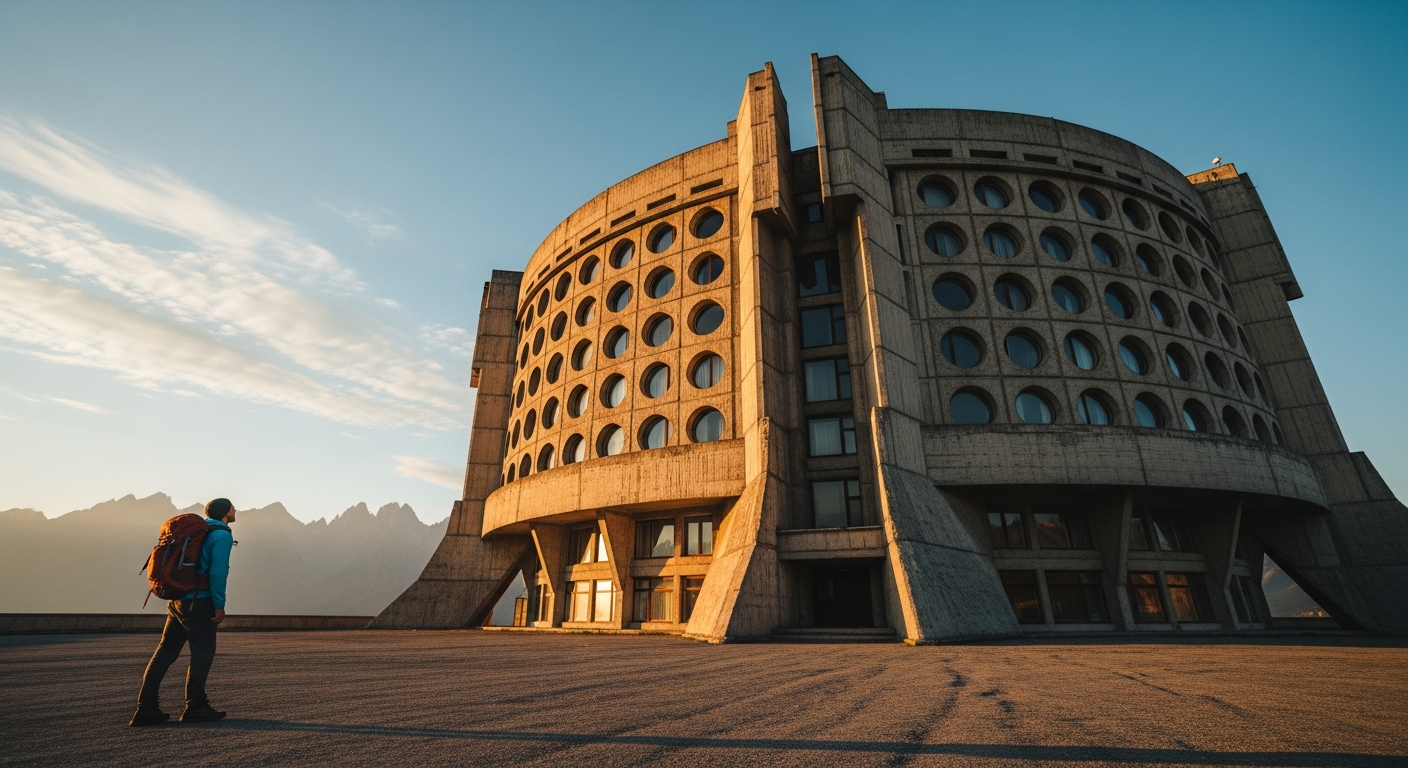
I’ll never forget standing in front of Tbilisi’s Ministry of Highway Construction building at sunrise, watching the first light hit its flying-saucer facade.
At the same time, a babushka swept the sidewalk below, completely unbothered by the concrete UFO hovering above her daily routine.
That moment crystallized what makes Soviet architecture tours so magical. These structures exist in the real world, not behind velvet ropes, and they’re still deeply woven into everyday life across Eastern Europe and Central Asia.
This complete guide cuts through the planning overwhelm with everything you need to experience these architectural marvels firsthand. Whether you’re working with a tight budget or limited vacation time, you’ll discover the most unforgettable Soviet architecture destinations, practical tour options, and local insider tips to maximize every moment of your journey.
I’ve spent the last three years photographing brutalist buildings from Vilnius to Bishkek, and I’m sharing exactly what works—and what doesn’t.
Why Soviet Architecture Tours Are the Ultimate Authentic Experience

Beyond Tourist Traps: Discovering Hidden Architectural Gems
Here’s what most travel guides won’t tell you: while tourists queue for two hours at Prague Castle, you can have Tbilisi’s Chronicles of Georgia monument entirely to yourself on a Tuesday morning. Soviet architecture offers something increasingly rare in European travel—authentic, uncrowded experiences with genuinely jaw-dropping visuals.
The global appreciation for brutalist and modernist design has exploded in the past five years, particularly among architects and photographers, but these sites haven’t yet hit mainstream tourist circuits. Instagram hashtags like #sovietmodernism have over 200,000 posts, yet when I visited the Buzludzha Monument in Bulgaria, I encountered exactly four other people. This is the sweet spot: visually stunning, culturally significant, and blissfully free of tour buses.
The architectural diversity is staggering. You’ll encounter everything from constructivist masterpieces with clean geometric lines to late-Soviet brutalism that looks genuinely alien. The Kyrgyz National Philharmonic in Bishkek resembles a concrete accordion; Yerevan’s Cascade Complex combines travertine terraces with contemporary art installations. Each building tells a story about Soviet ambitions, local adaptations, and the collision of ideology with reality.
Budget-Friendly Travel with Stunning Visual Impact
Let’s talk money. My ten-day Soviet architecture tour through Georgia and Armenia, including flights from London, cost £680 total. That’s less than three nights at a mid-range Paris hotel. Eastern Europe and Central Asia offer incredible value—you’ll pay €15-30 for excellent guesthouse accommodation, €8-12 for restaurant meals, and often nothing at all to access the buildings themselves.
Most Soviet architectural sites aren’t ticketed attractions. The Ministry of Highway Construction? Free. The Narkomfin Building in Moscow? Free to photograph from outside. Even guided walking tours in cities like Almaty run about €10-15 per person. The Palace of the Republic in Almaty charges 500 tenge (roughly €1) for entry, and that includes access to concert halls with spectacular Soviet-era interiors.
Public transportation remains absurdly cheap in most former Soviet republics. Tbilisi’s metro costs 50 tetri (€0.15) per ride; Bishkek’s marshrutkas (minibuses) charge 15 som (€0.15). You can photograph an entire city’s architectural highlights for the cost of a London coffee. The trade-off? You’ll navigate Cyrillic signage and occasionally find yourself on a bus with chickens. I consider this a feature, not a bug.
Maximize Your Limited Vacation Time
Soviet architecture exists in concentrated zones, making it perfect for travelers with only a week or two available. Tbilisi’s main brutalist buildings cluster in three neighborhoods—Saburtalo, Nutsubidze, and Vake—all accessible via a single metro line. You can photograph Yerevan’s highlights in two days by walking a circuit from the Cascade Complex through residential microdistricts to Zvartnots Airport.
This concentration means you’re never “just” doing architecture. I’d photograph the Druzhba Sanatorium in Yalta in the morning, swim in the Black Sea by afternoon, and eat spectacular Georgian food by evening. Soviet buildings integrate into broader cultural exploration rather than requiring dedicated pilgrimages. The Chronicles of Georgia sits above Tbilisi’s reservoir—locals come to picnic, kids skateboard on the plaza, and you’ll capture both architecture and authentic daily life.
The efficiency extends to multi-country trips. Georgia and Armenia share a border; you can bus from Tbilisi to Yerevan in six hours for €8. Kazakhstan and Kyrgyzstan connect easily via shared taxis. With smart planning, you’ll hit four countries in ten days without feeling rushed, seeing architecture that would require months to encounter in Western Europe.
The Most Unforgettable Soviet Architecture Destinations

Tbilisi, Georgia: The Secret Capital of Soviet Modernism
Tbilisi punches above its weight in Soviet architecture, and most visitors have no idea what they’re missing. The Ministry of Highway Construction building (locals call it the “Bank of Georgia building” now) sits on Akhvlediani Street—take the metro to Rustaveli, walk fifteen minutes uphill. Best photography happens between 7-9 AM when morning light hits the circular windows and the street traffic hasn’t started. The building functions as office space, so you can’t enter, but the exterior alone justifies the trip.
The Chronicles of Georgia monument requires more effort but delivers harder. Take bus 61 from Avlabari metro to the Tbilisi Sea (reservoir), then walk twenty minutes uphill. This massive monument features sixteen pillars, each 35 meters tall, covered in bronze reliefs depicting Georgian history. It’s technically unfinished—the Soviet Union collapsed before completion—which adds to its haunting atmosphere. Entry is free, crowds are nonexistent, and the views over Tbilisi are breathtaking. Bring water; there are no facilities.
Don’t miss Nutsubidze Plateau, a microdistrict of residential towers that look like they’re melting. Take the metro to Delisi, then marshrutka 33. These aren’t protected monuments—they’re where people live—so photograph respectfully from public spaces. The curved balconies and organic shapes represent late-Soviet experimentation with housing design. A local told me architects were trying to create “vertical neighborhoods” where residents would interact more than in standard rectangular blocks.
Budget breakdown for three days: hostel in Fabrika (€12/night), khachapuri and khinkali meals (€5-8), metro/bus (€1/day), occasional taxi for distant sites (€3-5). Total: roughly €60 excluding accommodation.
Yerevan, Armenia: Brutalist Beauty in the Caucasus
Yerevan’s Cascade Complex is the accessible introduction to Soviet architecture—it’s centrally located, well-maintained, and combines brutalism with contemporary art galleries. Built from pink tufa stone (volcanic rock), it features outdoor escalators climbing 572 steps up Kanaker Hill. Free to access 24/7, though the Cafesjian Center galleries inside charge 1,000 dram (€2). Go at sunset when the stone glows golden and locals gather for evening walks.
The real hidden gem is Zvartnots Airport—the old terminal, not the new one. Located 12 kilometers west of Yerevan, this modernist structure from 1980 sat abandoned until recent partial restoration. The circular design and space-age aesthetic make it a photographer’s dream. Take bus 201 from Republic Square (200 dram, €0.40), get off at Zvartnots, and walk around the perimeter. Security has relaxed in recent years; I photographed freely, though officially you’re supposed to get permission. Use judgment and be respectful.
The Soviet-era microdistricts sprawl across Yerevan’s outskirts—Charbakh, Arabkir, and Nor Nork neighborhoods feature massive residential complexes in varying states of repair. Unlike Tbilisi’s organic shapes, Yerevan’s blocks embrace geometric severity. Take the metro to Barekamutyun, then explore on foot. You’ll find Soviet-era murals, mosaics, and the occasional hammer-and-sickle still visible on building facades.
Free walking tour tip: Start at Republic Square (pure Soviet neoclassicism), walk up the Cascade, continue to the Komitas Pantheon, then loop back through Kond neighborhood. Four hours, zero cost, maximum architectural diversity.
Almaty, Kazakhstan: Where Soviet Meets Spectacular Nature
Almaty delivers something unique—brutalist architecture against a backdrop of snow-capped mountains. The Palace of the Republic on Abai Avenue is the centerpiece: a massive concert hall with a distinctive modernist facade that photographs beautifully with the Tian Shan mountains behind it. Entry costs 500 tenge (€1), and if you’re lucky, you’ll catch a rehearsal. The interior features Soviet-era mosaics and chandeliers that alone justify the visit.
Hotel Kazakhstan, visible from everywhere in central Almaty, is a 26-story brutalist landmark that’s been partially renovated. You can’t enter without staying there (rooms run about €40-60/night), but the exterior is iconic. Best photographed from Panfilov Park or Republic Square. The building’s stark geometric form contrasts dramatically with the ornate wooden Zenkov Cathedral nearby—the juxtaposition captures Kazakhstan’s architectural complexity perfectly.
The real adventure is Kazakhstan’s legendary bus stops, scattered across the countryside. These aren’t in Almaty proper—you’ll need to hire a driver or join a tour. Companies like Stantours run day trips (€80-100 per person, including lunch) visiting four or five stops. The structures range from whimsical to dystopian, each reflecting local culture through Soviet-era design language. I hired a driver through my hostel for €60 for the full day, which split between three travelers came to €20 each.
Almaty practical notes: The metro costs 80 tenge (€0.15) per ride; marshrutkas cost 150 tenge (€0.30). Hostels run €8-12/night, mid-range hotels €30-50. Meals at local cafeterias cost €3-5; restaurants €8-15. Learn basic Russian—English is limited outside tourist hotels.
Bishkek, Kyrgyzstan: The Hidden Gem for Architecture Lovers
Bishkek might be the most underrated Soviet architecture destination in Central Asia. The Kyrgyz National Philharmonic on Chuy Avenue is the crown jewel—its white marble facade and distinctive accordion-like pleats make it unlike anything else in the former USSR. Free to photograph outside; concerts cost 200-500 som (€2-5) if you want to see the equally spectacular interior.
The neighborhoods surrounding Osh Bazaar offer authentic Soviet residential architecture with the Ala-Too mountains as backdrop. This isn’t curated tourism—it’s daily life. Women hang laundry from Soviet-era balconies, kids play football in courtyards between concrete towers, and the architecture frames everything. Take marshrutka 265 from the city center (10 som, €0.10), get off at Osh Bazaar, and walk the surrounding blocks.
Bishkek’s advantage is walkability. The entire city follows a grid pattern established in Soviet times, with wide boulevards lined with trees and irrigation channels. I walked from the White House (government building, pure Stalinist neoclassicism) to Ala-Too Square to the Philharmonic to residential microdistricts in three hours, photographing constantly. No guides needed, no transport costs, just comfortable shoes.
Local secret: The Frunze House Museum (50 som, €0.50) preserves a traditional Russian cottage inside a massive concrete memorial building. The architectural contrast—tiny wooden house surrounded by brutalist monumentality—perfectly symbolizes Soviet cultural contradictions. It’s on Frunze Street, walkable from the center.
Budget reality: Bishkek is absurdly cheap. Hostel dorms cost €5-7/night, private rooms €15-20. Laghman and plov at local cafes run 80-150 som (€0.80-1.50). A full day of photography, meals, and local transport costs under €10.
Types of Soviet Architecture Tours: Finding Your Perfect Match

Self-Guided Walking Tours (Best for Budget Travelers)
Self-guided tours work brilliantly for Soviet architecture because the buildings exist in public space, not behind ticketed gates. I use a combination of Google Maps (marking sites in advance), the MAPS.ME app (works offline with downloaded maps), and Instagram location tags (shows you what others have photographed from each spot).
Start your research on Soviet-art.online and Cosmic Communist Constructions Photographed—both catalog buildings by city with addresses. Download maps for offline use, mark your targets, and plot walking routes connecting clusters of buildings. In Tbilisi, I created three routes: Saburtalo (Ministry of Highway Construction, residential complexes), Nutsubidze (melting buildings, experimental housing), and Vake (sanatoriums, cultural buildings).
Safety considerations: Don’t enter abandoned buildings alone. Floors collapse, squatters exist, and local police may not appreciate foreign photographers trespassing. Photograph from public streets and sidewalks—you’re legally safe and practically safer. If you desperately want interior shots of abandoned structures, hire a local guide who knows which buildings are structurally sound and legally accessible.
Local etiquette matters. These buildings house real people living real lives. Don’t photograph residents without permission, don’t block building entrances for shots, and don’t climb on structures. I carry a small notebook with “Can I take a photo?” written in Russian, Georgian, and Armenian—showing respect opens doors (sometimes literally).
Estimated budget: €0-20 per day beyond normal travel costs. Maybe you’ll buy a coffee at a Soviet-era cafe for atmosphere, or tip someone who lets you into a building’s courtyard. Otherwise, this is free exploration.
Organized Group Tours (Perfect for Limited Time)
Group tours excel at efficiency and access. Tbilisi’s Soviet Modernism Walking Tour (run by Tbilisi Free Walking Tours, though this one costs €15) covers six buildings in three hours with an architecture student guide who explains historical context and design principles. You’ll see more, understand more, and waste zero time getting lost.
Yerevan’s ARQA Tours offers Soviet Architecture Day Tours (€45 per person, minimum four people) that include transportation to Zvartnots Airport, several microdistricts, and lesser-known structures you’d never find independently. They handle permissions, know optimal photography times, and provide historical background that transforms buildings from “weird concrete things” into meaningful cultural artifacts.
For multi-city experiences, Steppe & Silk organizes custom Soviet architecture tours across Central Asia. Their seven-day Kazakhstan-Kyrgyzstan itinerary (€890 per person, double occupancy) includes Almaty, Bishkek, the bus stops, and several lesser-known sites, with accommodation, transport, and guides included. Expensive compared to DIY, but you’ll see twice as much in half the time.
What to expect: Groups rarely exceed 8-10 people. Tours involve substantial walking (5-8 kilometers typical). Guides vary in English proficiency—in Central Asia, expect accented but comprehensible English. Most tours include some free time for independent photography. Always ask about group size, walking distance, and whether transport is included before booking.
Time estimate: Half-day tours run 3-4 hours (€15-25), full-day tours 6-8 hours (€40-60), multi-day expeditions vary widely but figure €100-150 per day all-inclusive.
Private Photography Tours (Ultimate for Enthusiasts)
Private photography tours cost more but deliver access and timing impossible to achieve independently. I hired Giorgi in Tbilisi (found through Instagram, €120 for a full day) who took me to the Chronicles of Georgia at dawn, knew which residential complexes allow courtyard access, and had relationships with building managers who let us into normally locked areas.
The value isn’t just access—it’s knowledge. Giorgi explained that the Ministry of Highway Construction’s circular windows reference traditional Georgian wine vessels (qvevri), showing how Soviet architects incorporated local culture. That context transformed how I photographed the building. Good guides are educators who happen to know the best angles.
Finding authentic local guides requires work. Search Instagram hashtags like #tbilisiarchitecture or #sovietmodernism, find local photographers whose work you admire, and DM them asking if they do tours. Many don’t advertise formally but will guide for €80-150 per day. Verify their work, ask for references, and discuss your specific interests (pure architecture? Soviet history? Photography techniques?).
Photography-specific considerations: Private guides can schedule around golden hour, know which buildings have interesting shadows at specific times, and won’t rush you. When I photograph, I need 15-20 minutes per building to try multiple angles—group tours allow maybe five minutes. For serious photographers, private tours aren’t luxury; they’re necessity.
Investment range: €100-300 per day depending on location, guide expertise, and whether transport is included. In Central Asia, expect lower rates (€80-150); in Moscow or St. Petersburg, higher (€150-300).
Multi-Country Architecture Expeditions
Multi-country tours maximize architectural diversity in limited time. The Caucasus Circuit (Georgia-Armenia-Azerbaijan) works brilliantly because borders are close and buildings vary significantly. Georgia offers organic Soviet modernism, Armenia delivers geometric brutalism, and Azerbaijan (Baku) provides Soviet architecture mixed with oil-boom construction.
DIY multi-country planning requires 3-6 months advance preparation for visa research and booking. Georgians and Armenians get visa-free entry for most Western nationalities, but check current requirements. Kazakhstan offers 30-day visa-free entry for most Europeans and Americans; Kyrgyzstan gives 60 days. Always verify before booking flights.
Transport between countries: Marshrutka vans run Tbilisi-Yerevan (€8, six hours), Almaty-Bishkek (€12, four hours). Flights cost more but save time—FlyArystan operates budget flights across Central Asia (€30-60 one-way). I bused Georgia-Armenia for the scenery, then flew Almaty-Bishkek to save a day.
Border crossing reality: Georgia-Armenia is straightforward (30 minutes typical). Kazakhstan-Kyrgyzstan can be slow (1-2 hours) with occasional bureaucratic confusion. Carry passport copies, proof of accommodation, and patience. Never photograph border infrastructure—guards take this seriously.
Sample 10-day DIY itinerary: Tbilisi (3 days) → Yerevan (2 days) → Almaty (3 days) → Bishkek (2 days). Budget €600-800 including inter-country transport, accommodation, meals, and local tours. Organized equivalent costs €1,200-1,800 but includes guides, better hotels, and zero planning stress.
Planning Your Soviet Architecture Tour: The Complete Checklist

Best Times to Visit for Stunning Photography
Golden hour makes or breaks architectural photography, and timing varies dramatically by location. Tbilisi’s east-facing buildings (like the Ministry of Highway Construction) photograph best at sunrise (6-8 AM in summer, 8-10 AM in winter). The Chronicles of Georgia faces west—shoot it at sunset (7-9 PM summer, 5-7 PM winter) when the bronze reliefs glow.
Seasonal considerations matter more than you’d think. Central Asia’s summers (June-August) hit 35-40°C—brutal for walking tours, harsh light for photography. Spring (April-May) and fall (September-October) offer comfortable temperatures (15-25°C) and better light. Winter works in the Caucasus (milder, 5-15°C) but Central Asian winters are severe (often below -10°C).
The trade-off: summer means longer days and easier travel but worse photography conditions and tourist crowds (still minimal compared to Western Europe). Winter delivers dramatic snow-covered brutalism and zero crowds but short days and occasional access issues when snow blocks roads. I prefer late April-May and September-October for optimal balance.
Off-season advantages extend beyond weather. You’ll experience authentic local life when cities aren’t performing for tourists. That babushka sweeping under the flying saucer? She’s there year-round, but in summer she’s joined by Instagram influencers. Winter lets you see these buildings in their actual context, not as attractions but as living spaces.
Essential Gear and Preparation
Camera equipment recommendations span budgets. Smartphone photography works—I’ve seen stunning Soviet architecture shots taken on iPhone 12s. The key is a wide-angle lens (most phone cameras default to 26-28mm equivalent, which works). For dedicated cameras, bring a wide-angle zoom (16-35mm on full-frame, 10-24mm on crop sensor) for capturing massive buildings in tight urban spaces.
Practical gear matters more than expensive cameras. Comfortable walking shoes are non-negotiable—I walked 15-20 kilometers daily photographing Tbilisi. Weather-appropriate clothing means layers (mornings are cold, afternoons warm, evenings cold again).