
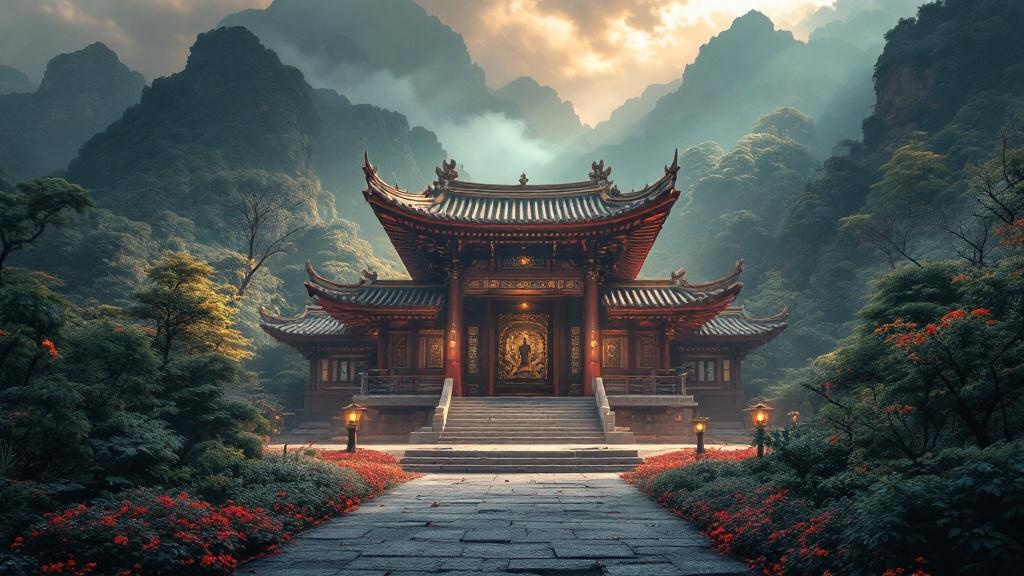
7 Buddhist Temples for Spiritual Healing

Imagine stepping through carved wooden doors into a space where golden light filters through ornate lattices, casting dancing shadows across ancient murals.
The scent of sandalwood incense mingles with cool mountain air, and the soft echo of prayer bells creates a rhythm that seems to slow time itself. This isn’t just a temple—it’s a sanctuary where your weary creative spirit can finally exhale.
When artist’s block builds walls around your imagination, or when self-doubt whispers that your work isn’t good enough, sometimes the best response isn’t to push harder at your easel or stare longer at your blank screen. Sometimes you need to step away entirely and immerse yourself in spaces designed for one purpose: awakening the soul.
Buddhist temples offer something extraordinary—they’re masterpieces of artistic expression *and* sanctuaries for spiritual renewal. Every carved detail, every brushstroke on ancient frescoes, every carefully placed stone represents an artist’s meditation made manifest. These sacred spaces don’t just house spiritual practice; they embody the creative process itself.
I’m taking you on a journey through seven captivating Buddhist temples that deliver both peace for your spirit and visual inspiration for your art. Whether you’re battling creative burnout, seeking fresh perspectives, or simply craving beauty that reminds you why you create in the first place, these temples offer lessons that transcend any single artistic medium. You’ll discover how ancient craftspeople solved the same creative challenges you face today—and how their solutions can transform your work.
Ready to see how spiritual healing and artistic awakening intersect? Let’s begin.
Why Buddhist Temples Speak Directly to the Creative Soul
Here’s what most people miss about Buddhist temples: they’re not just buildings for worship. They’re comprehensive artistic statements created by artists who understood something profound—that the act of creation itself is a spiritual practice.
Buddhist philosophy embraces concepts that directly combat the struggles you face in your studio. Impermanence teaches you to let go of perfectionism—that painting doesn’t need to be flawless, it needs to be authentic.
Mindfulness pulls you into the present moment, silencing the critical voice that compares your work to others. Present-moment awareness is exactly what you experience when you’re in flow, completely absorbed in your creative process.
The artisans who built these temples worked with meditative intention. They didn’t rush. They understood that patience, repetition, and attention to detail weren’t obstacles to creativity—they were the path itself.
When you study a temple’s intricate wood carvings or observe how a sculptor captured emotion in stone, you’re witnessing meditation made visible.
The visual elements in Buddhist temples function as masterclasses in fundamental artistic principles. Mandalas demonstrate perfect radial symmetry while teaching you about balance and focal points. Vibrant murals show you how to build complex narratives across large surfaces.
Expressive Buddha statues reveal how subtle shifts in gesture and expression convey completely different emotions. Temple architecture itself teaches sacred geometry, intentional use of negative space, and how to integrate human creation with natural landscapes.
Here’s the budget-friendly bonus: visiting temples (or exploring them virtually through high-quality photography and virtual tours) costs nothing compared to expensive art workshops or courses.
You can photograph details, sketch architectural elements, and study compositional techniques without purchasing costly art books.
Many temples welcome visitors for free or request only small donations. This makes them accessible inspiration sources regardless of your financial situation.
The temples we’re exploring offer specific, actionable lessons you can apply immediately to your creative practice. Let’s discover what each one teaches.
Borobudur Temple, Indonesia: Your Masterclass in Visual Storytelling
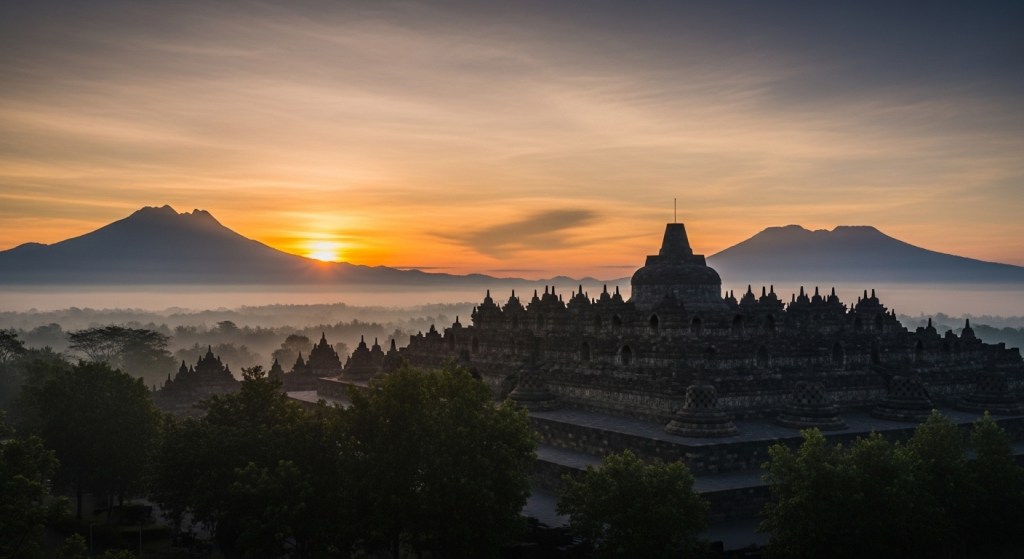
Borobudur isn’t just Indonesia’s most famous temple—it’s the world’s largest Buddhist monument and a stunning lesson in how to tell complex stories through visual art.
Picture this: nine stacked platforms forming a massive mandala when viewed from above, constructed from over two million blocks of volcanic stone.
As you walk the pilgrim’s path, you encounter more than 2,600 relief panels that narrate Buddhist teachings through sequential imagery.
These aren’t random decorations—they’re carefully planned visual narratives that guide you from worldly concerns at the base toward enlightenment at the summit.
The 504 Buddha statues positioned throughout the temple demonstrate something crucial for artists: variation within consistency. Each statue follows traditional iconography, yet subtle differences in hand positions (mudras), facial expressions, and posture create unique personalities.
This teaches you how to work within established frameworks while maintaining originality—essential for illustrators, character designers, and anyone creating series work.
The temple’s design mirrors the creative journey itself. You start at the base level, surrounded by detailed relief panels depicting earthly desires and consequences—the “darkness” of not knowing your artistic voice.
As you ascend, the imagery becomes more refined and abstract, representing increasing clarity. Finally, you reach the upper terraces where statues sit in meditation, facing outward toward the horizon—the enlightenment of finding your creative purpose.
For artists struggling with sequential storytelling, study how Borobudur’s relief panels build narratives. The ancient sculptors used size variation to indicate importance, overlapping figures to create depth, and architectural elements to frame scenes. Comic artists and illustrators can apply these exact techniques. Notice how the panels use visual rhythm—alternating busy compositions with simpler ones to control pacing.
Sculptors and 3D artists, observe how these craftspeople created the illusion of movement and depth in stone. Figures emerge from backgrounds at varying depths. Drapery flows with convincing weight. Hands gesture with anatomical precision despite being carved in hard volcanic rock. They accomplished this without modern tools—just patience, observation, and skill built through mindful practice.
The lesson Borobudur teaches? Your creative journey isn’t linear. You’ll circle back to earlier lessons, viewing them from higher perspectives. You’ll refine your skills gradually, layer by layer. And the path itself—the meditative practice of creating—matters as much as reaching the summit.
Wat Rong Khun, Thailand: Breaking Rules While Honoring Tradition
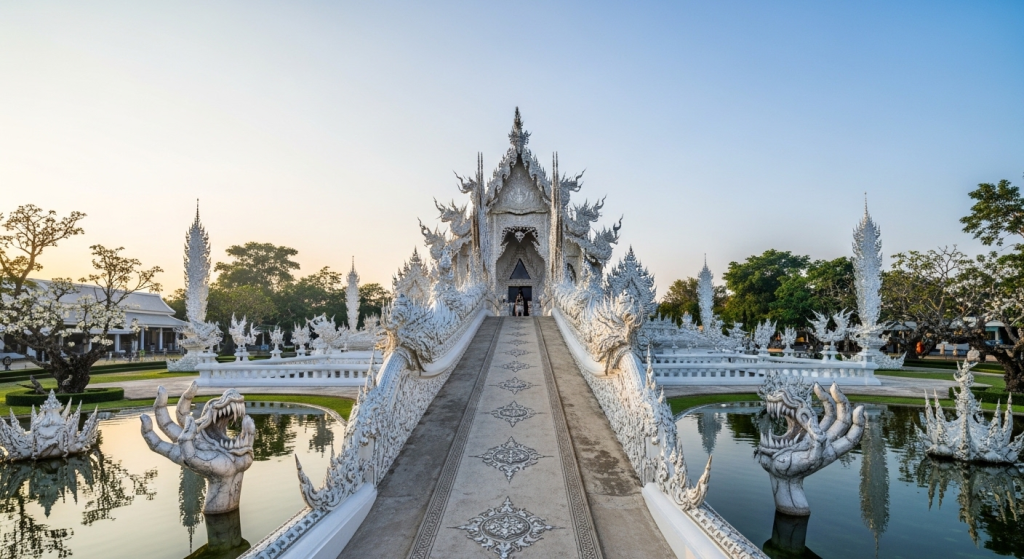
If Borobudur represents ancient mastery, Wat Rong Khun (the White Temple) proves that Buddhist temple art is alive, evolving, and boldly contemporary.
Artist Chalermchai Kositpipat began constructing this captivating white temple in 1997, and it’s still growing. The entire structure gleams white, covered in mirrored glass that catches light and creates an otherworldly shimmer. But here’s where it gets interesting for artists: alongside traditional Buddhist imagery, you’ll find murals depicting modern pop culture icons, superhero characters, and contemporary symbols woven into spiritual narratives.
This temple delivers a powerful message to artists lacking confidence in their unique vision: tradition and innovation aren’t enemies. Chalermchai respects Buddhist artistic heritage while fearlessly injecting his contemporary perspective. He’s not abandoning his roots—he’s extending them into the present moment.
The intricate white plasterwork resembles delicate lace, demonstrating how pattern and repetition create visual impact. Pattern designers and textile artists can study how small, repeated motifs build into breathtaking complexity. Digital artists working with procedural generation can observe how organic variation within systematic repetition prevents monotony.
The bridge leading to the temple’s entrance—called “the cycle of rebirth”—features hundreds of reaching hands emerging from below. This sculptural element teaches metaphorical visual language. The hands don’t literally represent hell; they symbolize human desires and attachments that prevent spiritual freedom. This same approach works in your art—using visual metaphors to convey abstract concepts makes your work more powerful and memorable.
Inside, murals challenge every expectation of what “temple art” should look like. Traditional Buddhist scenes share wall space with modern imagery, all rendered in vibrant colors with technical precision. This demonstrates that your medium’s history doesn’t limit you—it provides foundation for innovation.
The reflective surfaces throughout the temple create constantly changing light effects depending on time of day and weather. Painters exploring luminosity and atmospheric perspective can learn from how Chalermchai designed surfaces to capture and transform natural light. Your paintings don’t need to be static—consider how changing light conditions could reveal different aspects of your work.
Wat Rong Khun proves that respecting your craft’s traditions doesn’t mean copying them. Study the masters, understand the principles, then express your unique voice. The art world needs your perspective, not another imitation of someone else’s.
Angkor Wat, Cambodia: Where Sacred Geometry Meets Natural Beauty
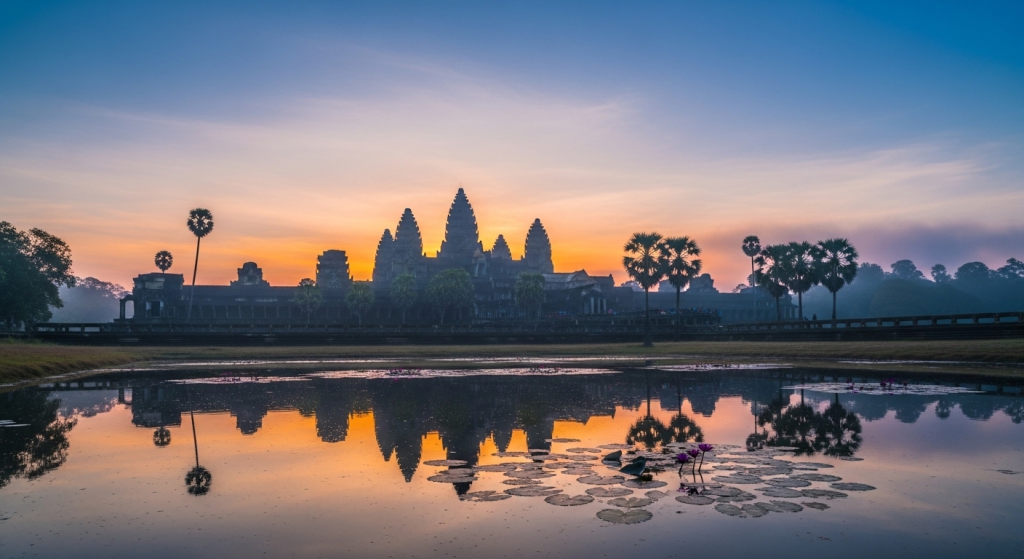
Angkor Wat sprawls across 162 hectares, making it the world’s largest religious monument. But size isn’t what makes it essential study material for artists—it’s the stunning integration of mathematical precision with organic beauty.
The temple’s proportions follow sacred geometry with almost obsessive precision. The central tower rises exactly 65 meters, representing Mount Meru, the center of the universe in Buddhist cosmology. The entire complex forms a mandala when viewed from above, with perfect symmetry along both axes. Yet despite this rigid mathematical structure, the temple feels organic, alive, harmonious with its surrounding landscape.
This teaches you something crucial about composition: rules and intuition work together. Sacred geometry provides structure, but artistic sensitivity determines how that structure feels. Study how Angkor Wat uses the golden ratio in its proportions, then observe how trees, water features, and natural light soften that mathematical perfection into something breathtaking.
The bas-reliefs covering over 1,200 square meters of wall space demonstrate how to sustain visual interest across massive surfaces. These aren’t random scenes—they’re carefully choreographed narratives with visual rhythm. Complex battle scenes alternate with quieter moments. Dense compositions balance against areas of relative simplicity. This principle applies whether you’re designing a graphic novel, creating a mural, or planning a photography series.
The famous apsara carvings—over 1,800 celestial dancer figures—offer invaluable lessons for figure artists. No two are identical despite following traditional forms. Each has unique jewelry, different hand positions, varied facial features, and distinct postures. This demonstrates how to create diversity within consistency, essential for character designers and illustrators working on projects requiring multiple similar-but-different figures.
The temple’s integration with nature teaches another vital lesson. Trees grow through ancient stones. Water features reflect architectural elements. Sunrise and sunset transform the entire complex through changing light. The artisans who built Angkor Wat understood that their creation would age, weather, and be reclaimed by nature—and they designed with that impermanence in mind.
This addresses a common creative struggle: letting go. Your artwork will age, be reinterpreted, perhaps be forgotten. That’s not failure—that’s the natural cycle. Create with full commitment while accepting impermanence. The beauty of Angkor Wat today includes the moss, the weathering, the trees growing through ruins. Your work’s imperfections and evolution over time are part of its story.
Todai-ji Temple, Japan: The Power of Restraint and Negative Space
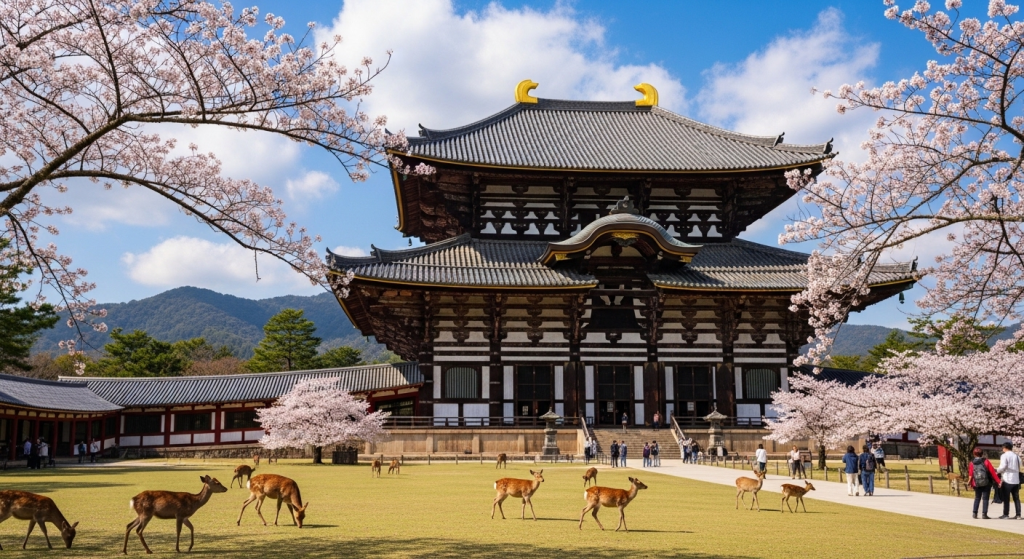
Todai-ji Temple in Nara houses the Daibutsu—a 15-meter bronze Buddha statue that weighs over 250 tons. The statue sits within Japan’s largest wooden building, a structure rebuilt multiple times over centuries yet maintaining its essential character.
Japanese Buddhist aesthetics embrace wabi-sabi—finding beauty in imperfection, impermanence, and incompleteness. This philosophy directly combats the perfectionism that paralyzes many artists. The wooden structure shows its age. The bronze Buddha has weathered and developed patina. These aren’t flaws—they’re evidence of authentic existence.
The concept of *ma*—negative space or meaningful emptiness—appears throughout Todai-ji’s design. The vast interior space surrounding the Buddha statue isn’t wasted area; it’s intentional breathing room that makes the statue’s scale comprehensible. Without that emptiness, the Buddha would feel cramped despite its massive size. This principle transforms every art form: paintings need negative space to rest the eye, music needs silence between notes, writing needs white space around text.
The guardian statues at the temple entrance—the Nio—demonstrate dynamic sculpture at its finest. These muscular figures capture explosive movement frozen in time. One has mouth open (representing the beginning sound “ah”), the other mouth closed (representing the ending sound “un”). Together they symbolize birth and death, beginning and end, alpha and omega. Study how the sculptors conveyed power, motion, and emotion in static wood. Notice the tension in muscles, the twist of torsos, the aggressive forward lean.
Todai-ji teaches minimalism as a response to creative overwhelm. When you’re drowning in artistic choices, strip back to essentials. What’s the core emotion you’re trying to convey? What’s the minimum necessary to communicate that? The temple’s aesthetic proves that restraint creates power. A single well-placed element in negative space commands more attention than a cluttered composition.
The wooden architecture demonstrates working with natural materials’ inherent qualities rather than fighting them. Wood grain becomes decorative element. Joinery becomes visual interest. Natural weathering becomes patina. Apply this to your budget constraints: work with what you have, let materials be themselves, find beauty in limitations rather than lamenting what you can’t afford.
For artists struggling with perfectionism, Todai-ji offers permission to embrace wabi-sabi. That “mistake” in your painting might be the most interesting element. That unexpected color shift could become your signature technique. Those limitations you’re fighting might be the constraints that force your most innovative work.
Three More Temples That Complete Your Creative Journey
Tiger’s Nest Monastery in Bhutan clings to a cliff face 3,000 feet above Paro Valley, teaching you that dramatic setting amplifies artistic impact. The challenging pilgrimage hike mirrors your creative journey—difficult, sometimes discouraging, but ultimately rewarding. Study how this temple uses its environment to create visual drama. The composition principles you observe—human-made structures against organic rock formations, scale contrast, strategic placement—apply directly to photography, painting, and digital art.
Bagan’s temple complex in Myanmar presents over 2,000 ancient temples dotting the landscape, creating an artist’s paradise. This abundance teaches a liberating lesson: there’s no single “right way” to approach your art. Similar functions—temples for worship—expressed through infinite creative variations. Some temples are massive, others intimate. Some feature elaborate decoration, others embrace simplicity. Some contain vibrant frescoes, others rely on architectural form alone. This diversity encourages confidence, especially for beginners who think they need to follow one “correct” approach.
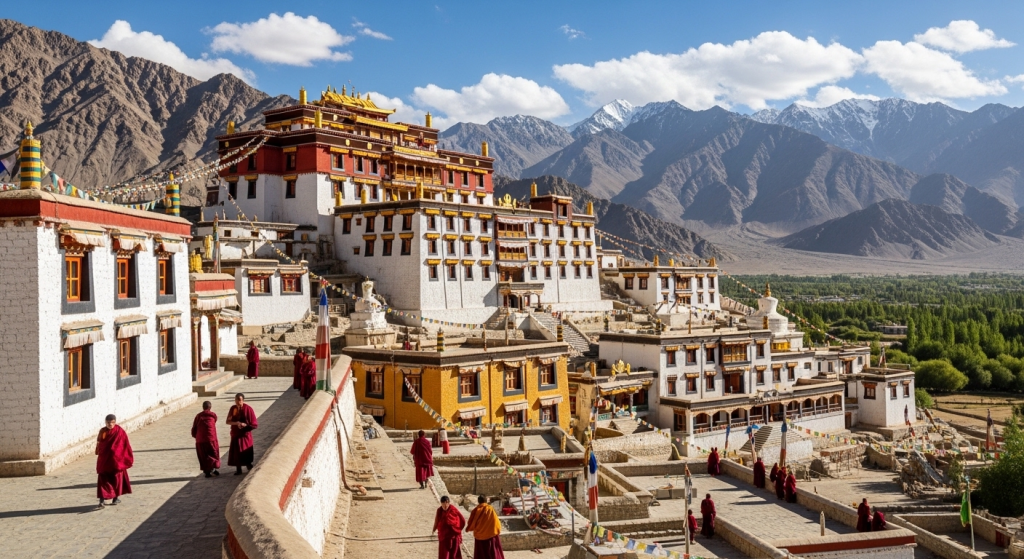
Thiksey Monastery in India cascades down a Himalayan hillside in brilliant white buildings adorned with vibrant thangka paintings and colorful prayer flags. The bold, saturated colors in Tibetan Buddhist art demonstrate fearless color theory. These artists didn’t shy from intense reds, deep blues, and brilliant golds placed in direct contact. Study how color carries symbolic meaning beyond mere decoration. Observe thangka painting techniques—precise lines, patient layering, mineral-based pigments—that create artworks lasting centuries.
These three temples add essential lessons to what you’ve already learned: boldness in composition, diversity in approach, and fearless use of color.
Bringing Temple Wisdom Into Your Creative Practice
These seven temples offer distinct lessons that combine into a comprehensive artistic philosophy. Borobudur taught you visual storytelling and the creative journey as spiritual path. Wat Rong Khun showed you how to innovate while respecting tradition. Angkor Wat demonstrated sacred geometry harmonizing with natural beauty. Todai-ji revealed the power of restraint and negative space. Tiger’s Nest proved that dramatic setting amplifies impact. Bagan celebrated infinite creative diversity. Thiksey demonstrated fearless color and patient technique.
But here’s what matters most: spiritual healing and creative renewal are interconnected. When you care for your spirit—through meditation, mindfulness, exposure to beauty, connection with something larger than yourself—your art deepens. The temples we’ve explored weren’t created by artists separate from spiritual practitioners. They were created by artists *as* spiritual practice.
Your creative work is your meditation. Your studio time is your temple. The mindful attention you bring to mixing colors, shaping clay, or composing photographs mirrors the devotion Buddhist monks bring to their practice. When you understand this, artist’s block transforms from creative failure into a signal that you need spiritual renewal.
Here’s how to apply temple wisdom starting today: Create a visual inspiration board featuring imagery from these temples. This costs nothing beyond internet access and gives you a reference library of compositional techniques, color palettes, and design principles. Develop your own creative ritual inspired by monastic discipline—perhaps lighting a candle before you begin work, or taking three mindful breaths to center yourself. Practice wabi-sabi by completing one artwork without revision, accepting whatever emerges. Study one temple element deeply—maybe Angkor Wat’s apsaras—and create your own variation series.
These temples have stood for centuries, weathering storms, wars, and time itself. Their beauty endures because it was created with patience, skill, and devotion. Your art can carry that same quality. Not through copying ancient styles, but through embracing the principles that made those styles timeless: mindful practice, technical skill developed through repetition, and creation as spiritual expression.
Your artistic journey is sacred. Treat it that way. Visit these temples if you can—or explore them virtually if you can’t. Let their beauty remind you why you create. Let their lessons guide your practice. Let their existence prove that art created with devotion transcends time, culture, and individual ego to touch something universal.
Now step into your studio with fresh eyes. You’re not just making art—you’re building your temple, one brushstroke at a time.